Sign up to the Newsletter to receive monthly updates on the latest Lacanian news
New Publications
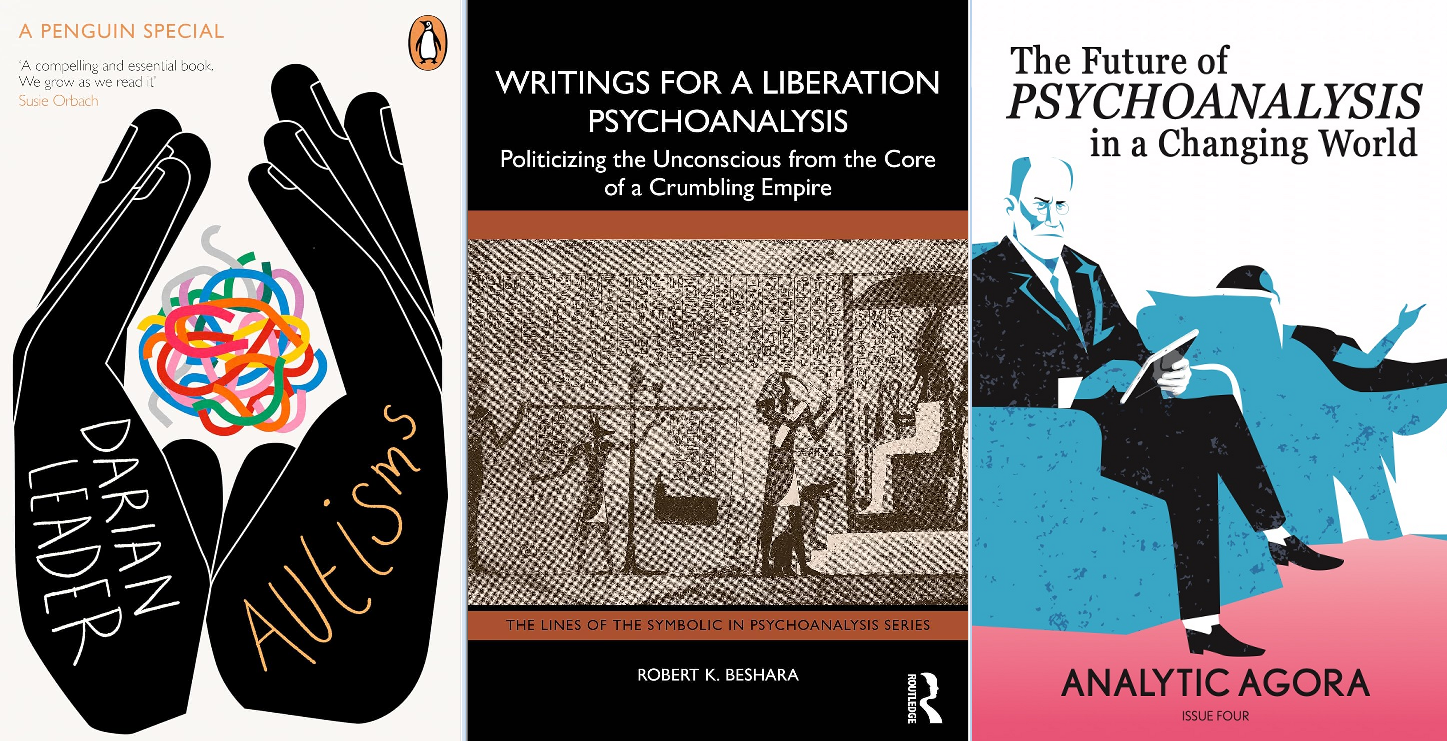
Autisms by Darian Leader was released in October, presenting a serious study of autism and the autistic spectrum from one of the most well-known psychoanalysts working in the Freudian-Lacanian tradition today. Drawing attention to the absence of agreement on the cause or clinical picture of autism – now as in the past – and the way it is perceived at times as a pathology, at others an identity, Leader carefully reviews the epidemiological, nosological and diagnostic questions that the burgeoning category of autism raises. His reflections touch on themes harmonic with those we deal with in the Lacanian field, even when not unique to it: questions of the body and space, containing and separating, and naming and nomination are brought into dialogue with more established concepts in psychoanalysis such as repetition, identity of perception, and Fort-Da. This is a careful and well-researched book that draws sensitively on the testimonies of autistic people in considering how they have been assessed and treated over almost a century.
Writings for a Liberation Psychoanalysis: Politicizing the Unconscious from the Core of a Crumbling Empire by Robert K. Beshara was published by Routledge last month. It proposes a ‘Psychoanalysis of the Oppressed’ or ‘Liberation Psychoanalysis’ as a contrast to the colonial logic that Beshara sees characterising traditional psychoanalytic institutions, in their tendency to pathologise the marginalised rather than challenging the structures that oppress them. In attempting to link transmodernity and decoloniality to the Freudian-Lacanian tradition, Beshara uses the contributions of thinkers like Edward Said, Paulo Freire and Enrique Dussel to propose a roadmap towards a reimagining of psychoanalysis that forefronts ethical listening and free association. An online launch event for the book will also take place on Sat Oct 3 via livestream with a series of guest participants.
Zoological Lacan: A Lacanian Framework for Animality by Teddy Duncan Jr has just been published by Routledge. It considers questions about animal subjectivity and the epistemological challenges that animals present, suggesting that a return to Lacan can resolve many of the lacunas within our comprehension of them. Using the Lacanian triad (the symbolic, the imaginary, and the Real), Duncan develops a “Zoological Lacanianism” that not only delineates a psychoanalytic understanding of animal interiority but also supplies fresh insights into animal behavior and subjectivity, exceeding Lacan’s direct comments on animality. This book extends Lacan’s thought by providing new theoretical interventions on topics such as animal interiority, communication, guilt, jouissance, trauma, the unconscious, and human-animal love. While carefully avoiding collapsing the subjectivity of animals and humans, animals are shown to be psychoanalytic subjects.
Deleuze, Lacan, and the Becoming of Sexuation by Matt Lovett was released last month by Routledge and contends with how to reconcile the positions of these two very different thinkers on the topics of sexual difference and gender theory. Drawing on Lacan’s work of the 1970s on sexuation, and via two other thinkers – Luce Irigaray as a theorist of sexual difference and Judith Butler as a theorist of gender – the author arrives at the proposal that in Delueze’s use of psychoanalysis we can find a version of sexuation which can hold sexual difference and gender theories together.
Myth Psychoanalysis: Freud, Lacan and Lévi-Strauss by Yehuda Israely deals with how we craft symbolic reality using myth. Approaching Freud’s case studies as myths and looking at how Freud used the classical myths of antiquity to conceive of the unconscious, Israely traces the development of how myth was thought about – and thought about as a tool for thinking – by Lévi-Strauss, whose structural anthropology was to become heavily influential on Lacan’s idea of the neurotic’s individual myth.
Lacanian Non-Rapport in the Novels of John Fowles by Mahitosh Mandal is new from Routledge and deals extensively with Lacan’s theory of the sexual non-rapport. Although Fowles repeatedly acknowledged his engagement with psychoanalysis, his novels have rarely been examined in relation to Lacan’s theorisation of sexual non-rapport. This book argues that the persistent misrecognitions of love and the recurrent failures of relationships in his fiction are structured by the Lacanian insight that “there is no sexual relationship.” Through detailed readings of Fowles’s six novels, the study demonstrates how Fowles’s characters confront the structural impossibility of sexual rapport and attempt to negotiate it through fantasy, desire, and symptom. By bringing Lacanian theory into dialogue with Fowles’s novels, the study offers a new interpretation of one of the most distinctive voices of twentieth-century British fiction.
Among the journals, the fourth issue of Analytic Agora, the journal of the College of Psychoanalysts-UK, is out now and available to buy in digital download or paperback. The papers collected here were first given at The College’s 2025 annual conference, Psychoanalysis in a Changing World, and they take up the conference’s questions from strikingly different directions. The contributors are Berjanet Jazani, Darian Leader, Gwion Jones, Erica Burman, Andrew Hodgkiss, Francesca Brencio, Michael O’Loughlin, Eddie Araya Villalobos, Ivan Ward, Fanis Lyrintzis and Daniela Oliveira Grund.
Upcoming Events
On Sat 3rd October, the London Society of the New Lacanian School will hold two linked events in person in London, both free. The first (11am) is an Open Day to introduce the School, the Society and its Programme of activities for the year. This is aimed at those who want to know more about what the London Society does and how it relates to the New Lacanian School. In the afternoon (2pm) there will be a Cartel Event. This is an opportunity for those who have been in cartels to present the products of their cartel work and to reflect on the process of being in a cartel. If you are new to cartels, it is also a chance to learn about what they are and how they work.
Also on Sat 3rd October, Corpo Freudiano Vancouver (formerly Lacan Salon) will be hosting the second of two sessions of Topology with Juan Luis de la Mora. In this workshop, participants will construct and play with surfaces like the torus, Möbius strip, Klein bottle, and cross-cap, and explore some of the experiences and questions that take shape on these objects. As a sample of what to expect, a short video from the first session of the workshop is here. The event is open to all but registration is required whether attending in-person or online.
Beginning Sunday 4th October, Lacan/UK’s introductory year-long programme explores Jacques Lacan’s Four Fundamental Concepts of Psychoanalysis in the context of contemporary debates on mental health. Twenty lectures across the year move through Transference, Repetition, the Unconscious and the Drive. Each year the course covers Lacan’s text in a new way, and this year there will be a specific emphasis on the drive. The lectures will take place on the first and third Sunday of the month at 9:30am London time (BST/ GMT). Those both new to Psychoanalysis and those experienced in its theories and practice are invited to join in the discussion of Lacan’s text.
On 5th October the RU Center for Psychoanalysis begins its new season. This will start with Dr Lara Sheehi presenting on Fanon, providing the foundation for a close reading of her book From the Clinic to the Streets: Psychoanalysis for Revolutionary Futures which RU Center will start on 14th November and run through 11th December 2027. Then on 14th October Mary Wild returns with Neurosis on Film, as part of her series of events on psychoanalysis and cinema. On 24th October, Dr Dan Collins will join to introduce his translation of Lacan’s Seminar XXIV, which will jumpstart the second year long study group: Reading Lacan’s Seminar XXIV, beginning Saturday, November 21st and running through November 13th, 2027. Finally, on 28th October, Dr Mikita Brottman will present The Uncanny as Creative Catalyst. Dr Vanessa Sinclair will also begin Psychoanalytic Supervision groups, with two starting in October, open to clinicians or students studying to become clinicians.
Beginning Fri 16th October, Lacan Tehran will start a series on Anxiety and Its Limits: Four Masterclasses with Four Lacanian Psychoanalysts, forming part of its course in the second half of the year on Jacques Lacan’s Seminar X, Anxiety. The series brings together four psychoanalysts from the Colorado, Polish and Mexico Forums, from the School of Psychoanalysis of the Forums of the Lacanian Field (IF-EPFCL), each offering a distinct reading of Jacques Lacan’s seminar. In Seminar X, Lacan approaches anxiety through the subject’s relation to the desire of the Other and develops the function of object a as the cause of desire. His formulation that anxiety is “not without an object” shifts the question from the absence of an object to what occurs when lack itself comes to be lacking. Across these four meetings, participants will work with questions concerning anxiety, desire and jouissance; the distinction between acting out and passage à l’acte; and Unheimlich. The series will conclude with a reading of the seminar through the question of the ethics of hate. To register, email the address on the flyer linked above.
On Saturday 7th November, the Race & Culture Committee at the Guild of Psychotherapists will hold the latest in its series of online seminars on Decolonising Psychoanalysis. Prof Suki Ali will present ‘Mixed Race, Post Race’ 30 years on: Same Difference? Prof Ali has written about Lacan and feminist epistemology, and is Professor (Education) in the Department of Sociology at LSE. Surplus income from the seminars goes to support the low-cost clinic of the Guild of Psychotherapists.
The Analytic Forum has announced a new course on ‘Perversion: Clinical and Theoretical Perspectives’, with Stephanie Swales & Derek Hook. This online seminar series will run for 8 weeks between 9th January and 27th February 2027. It will consider perversion first and foremost as a clinical structure, asking what conceptual resources Freudian and Lacanian psychoanalysis provide for recognising it, differentiating its forms, and working with it ethically in the clinic. A reminder too that Derek Hook’s course for The Analytic Forum, Psychoanalysis and Racism: Fanon with Lacan, will begin on 10th Oct. It will question whether psychoanalysis has done enough to understand racism and the colonial legacies that continue to shape contemporary society.
New Videos and Podcasts
Lacan Web Television on YouTube added another address by Jacques-Alain Miller to its Miller TV playlist last month. ’39 of Fever’ was delivered at the École normale supérieure on 9th September 2011 to mark the 30th anniversary of Lacan’s death. The title of this address is taken from the reading of an extract from Seminar XVI, from a chapter Miller had titled ‘High Fever’. The venue itself has significance, being the institution that Lacan was expelled from 42 years prior to this moment. English subtitles are available.
Prof. Dr. Samuel McCormick’s Lectures on Lacan series has now completed the exploration of Lacan’s Seminar XXIII, with the videos from this series now on YouTube. The new series on Seminar XXIV is underway, having begun last month, but with meetings up to 20th November and recorded lectures provided to all participants along with online discussions, there is still time to join by signing up here.
Derek Hook revisits the topic of perversion in a new YouTube series. ‘Substructures of Perversion (1): Disavowal from Freud to Lacan’ looks at Lacan’s comments in Seminars X and XVI on perversion. Hook considers the status of the gaze and the voice in perversion, the question of who enunciates the law, and how object a appears differently in perversion compared to neurosis.
Donald Kunze offers two new YouTube videos on adoxia (a method or principle starting from a seemingly incorrect premise that is later transformed or shown to have deeper underlying significance). He considers adoxia a “principle of empiricism as well as quantum speculation” belonging at the centre of psychoanalysis. The first video provides a detailed introduction to this complex but historically rich subject; the second video approaches Lacan’s Seminar IX by proposing the replacement of its notoriously tricky topology with the idea of adoxia, insofar as the latter is “a logic of the universal’s emergence from the particular.”
New Resources and a New Research Study
On Freud2Lacan.com over the last month more fresh translations have been added and are now available. Last month’s inclusions of special interest to Lacanians come from the journal Scilicet, which Lacan edited. From Scilicet 6/7 in 1975 are texts Écriture et sexuation (number 240 on the Lacan page), L’alcoolisme (number 264), La raison avant Freud (number 268), Discours philosophique et discourse psychanalytique (number 267) and Note sur la beauté (number 241). These texts were translated by Anthony Chadwick and Richard G. Klein respectively. Also, on the Freud/Philosophy page, is a side-by-side translation of Freud’s ‘Types of Onset in Neurosis’ (number 28). Freud scholars may also be interested in the translation of Carl Abel’s 1884 paper, ‘The Antithetical Meaning of Primal Words’, (number 21 on the Freud/Philosophy page) which is now available in its original German and in a brand new English translation – no other translation exists. The text is of interest because of its influence on Freud, who was to write his own paper with the same title in 1910. A side-by-side translation of the latter is also available on the Freud/Philosophy page.
Lastly, Dr. Chris Bell (University of Dallas) and Dr. Stephanie Swales (Dublin City University) are beginning a new IRB approved research study on the topic of personal change and transformation resulting from a completed Lacanian analysis.They are seeking participants who meet the following criteria:
· You have completed a Lacanian analysis within the previous two years that you consider to have been by and large successful.
· You are currently in analytic formation or have completed analytic formation at a psychoanalytic school or institute..
· You are interested to speak about the changes you experienced from your analysis.
Participation involves one confidential on-line, audio-recorded interview lasting between 50 minutes and an hour and a half. Your interview will be transcribed and de-identified, and pseudonyms will be assigned to all names mentioned. As a token of appreciation for your participation in this study, you will receive an $80 Amazon gift card.
Although there is quite a lot of theoretical literature on the types of change associated with undergoing a Lacanian psychoanalysis, there is a dearth of empirical research on analysands’ experiences of such change. As such, your participation in this study will make an important contribution to the field of Lacanian psychoanalysis.
If you are interested in participating and would like further information, click here for the flyer with contact details to participate.
Got news? Get in touch.
Sign up to the Newsletter to receive monthly updates on the latest Lacanian news


