Sign up to the Newsletter to receive monthly updates on the latest Lacanian news
New Publications
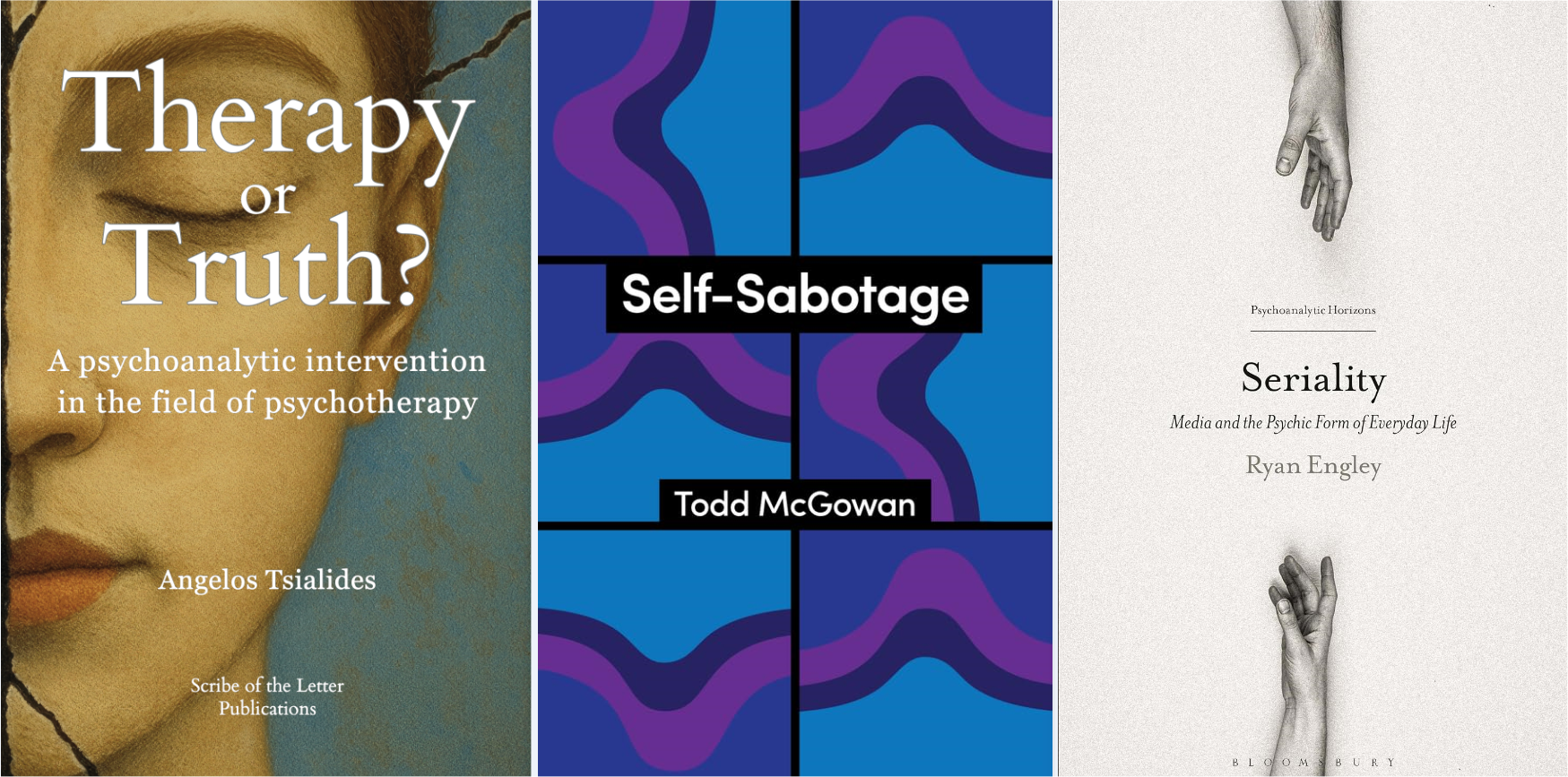
Therapy or Truth? by Angelos Tsialides, published in August, is a critical introduction to the encounter between psychoanalysis and psychotherapy in terms of the fundamental difference in the questions each asks of human suffering. Tsialides argues that contemporary psychotherapies tend, in different ways, to orient themselves towards change, adaptation, well-being, or the construction of a more workable narrative of the self. Psychoanalysis, by contrast, begins from the proposition that the subject is not fully transparent to itself, and that this very lack of transparency constitutes its pursuit of truth, which emerges precisely where its speech escapes its intentions. The book therefore asks what is at stake when the aim of treatment shifts from truth to therapy – or, what is lost when the question of truth is replaced by the promise of therapy – and whether the relief of suffering necessarily coincides with a fundamental shift in how one is implicated in it. Drawing on Freud and Lacan and informed by the practice of psychoanalysis, while avoiding unnecessary technical language, Therapy or Truth? introduces psychoanalytic ideas through questions arising from everyday experience and the clinic: anxiety, desire, the symptom, repetition, love, transference, and the relation to others. The book is therefore both an accessible introduction to a Lacanian orientation in psychoanalysis, offering those unfamiliar with the field a clear entry into its fundamental ideas, and a clinically rich work that draws extensively on insights arising from analytic practice, including observations of relevance to the experienced clinician.
Two new books have just come out from the respective co-hosts of the Why Theory podcast, which has covered many psychoanalytic ideas over the years, with discussions framed by Lacanian theory. Firstly, Seriality: Media and the Psychic Form of Everyday Life by Ryan Engley was published in August and looks at the narrative structure of instalment-based storytelling that Engley sees as common to both media and psychic structure. Characterised by gaps, delays, and constraints he posits how these help us negotiate the relation between self and other and the traumas of contemporary life. The second chapter focuses specifically on Lacan and the serial symbolic. Secondly, Self-Sabotage: How We Try Not to Flourish by Todd McGowan, was released just before August by Polity. In it he considers how the drive to sabotage ourselves outweighs the pleasures that come from flourishing, and looks at how the effects of this are felt, from our personal relationships to our political predicaments. Self-sabotage is nonetheless, he argues, a force with a creative power, and through the sacrifice of ourselves we create sublime value in the world. In an allusion to Lacan’s famous pronouncement on sublimation in Seminar VII (p.112), McGowan argues that this raises the value of the objects we pursue to a dignity beyond the ordinary.
Lacan for Criminologists: Zemiology, Ultra-Realism, and Harm Reduction by Rafe McGregor, David Grcki, and Ema Lalic was published by Routledge last month. The book approaches Lacan as a structuralist, rather than as a psychoanalyst or psychiatrist, to consider the utility of his ideas for the field of criminology. In particular, the authors are interested in the ultra-realist framework of critical criminology, a modern theoretical perspective developed by scholars like Steve Hall that explains crime as a direct result of the hyper-competitive, selfish culture found in advanced neoliberal capitalism. Towards the end of the book they propose a Lacanian theory of zemiology, the study of social harms. Lacan himself was not a total stranger to criminology, having co-authored a paper on it with fellow psychoanalyst Michel Cénac in 1950. Though it must be said that this paper – ‘A Theoretical Introduction to the Functions of Psychoanalysis in Criminology’ – is one of the least-read in the Ecrits.
Performance and Real Relationships: Family, Kinship and Love in Contemporary Theatre by Ildikó Rippel was released last month and uses Lacanian psychoanalytic theory alongside Derridian poststructuralism, feminist and queer theory, to think about how theatre is a way of ‘doing family.’ By this is meant the performative, embodied and affective practices that constitute family, rather than the family as an institution. Rippel argues that when the familial is brought onto the stage and performed with real family members it brings out sociopolitical tensions and carries a political potential which “holds the capacity to perform utopian realities.” Theatrical performance with family can create what she calls “authenticity effects” that disrupt representation.
The Proletariat Discourse: Rethinking Marx in Lacanian Psychoanalysis by Chyatat Supachalasai was also among the new releases in August, published by Routledge. Using Lacanian psychoanalysis, Supachalasai offers a reinterpretation of Marx’s concept of the proletariat, arguing that Lacan’s ‘fifth discourse’ (the capitalist discourse, as he outlined it in Milan in 1972) encompasses a non-relational aspect which Supachalasai terms the ‘proletariat discourse.’ The author posits a subject of resistance to capitalism, and reflects on how to understand Lacan’s comments in Television about “the way out of capitalist discourse.”
Upcoming Events
With the start of the new academic year many groups, schools and associations have announced their seminar programmes for the 2026-2027 calendar, with online participation a possibility for many events. New York’s Après-Coup Psychoanalytic Association is offering events on transference, autism, mourning, and topology as part of its programme; while CFAR in London has a programme that is strong on themes of sublimation and creativity for its winter term. Also in the UK, the London Society of the New Lacanian School will have its Open Day on 3rd October. The morning will introduce the School, the Society and its programme for the year ahead; in the afternoon there will be a Cartel Event in which those who have been working in a cartel will present their work. Back in the US, the Lacanian School of Psychoanalysis in Los Angeles has a varied programme in which many events are grounded in a particular one of Lacan’s texts. A special event on 6th September will also see Stephanie Swales and Derek Hook discuss Working with Masochism from theoretical and clinical perspectives. In Ireland, the Freud Lacan Institute (FLi) is offering an 8-week introductory course in the form of its Certificate in the Foundations of Psychoanalysis, which starts on 1st Oct. Its Program of Continuing Studies runs on Saturdays once a month and applications for the next full programme intake are being accepted until 7th September. Individual seminars in the series may be enrolled for at any time of the year. There are also two short courses beginning in September with the FLi: a dreams workshop with Diana Cuello starting on 18th September and a neuropsychoanalysis program with John Dall’Aglio beginning on 26th September. Finally, the International Institute of Psychoanalysis begins its Psychoanalytic Formation programme in mid-September, which will delivered entirely online. Among its upcoming talks are Fabrice Bourlez on ‘Posthuman Loves’, which will take place on 12th September, online, and for free.
Beginning 7th September, Eugénie Austin of Lacan in Australia will be organising a series of Reading Freud sessions on Freud’s 1919 essay The Uncanny. The meetings are free, online, open to all and recorded. The series will consider the uncanny in relation to ambivalence, repression and its return, anxiety, repetition compulsion, doubles, ghosts and death, with plenty of Lacanian contextualising. The ongoing Reading Lacan group, which meets weekly, is currently reading Lacan’s Seminar VII, The Ethics of Psychoanalysis. Participation in these is also free, online, recorded and open to all.
On 18th-19th September the Lacan Today Conference takes place at Ghent University, Belgium. The conference is addressed to scholars, clinicians, artists, and researchers with a sustained and specific interest in the work of Jacques Lacan and in Lacanian psychoanalysis, in all its clinical, cultural, and social applications. Registration is still open and the full programme is published on the conference site.
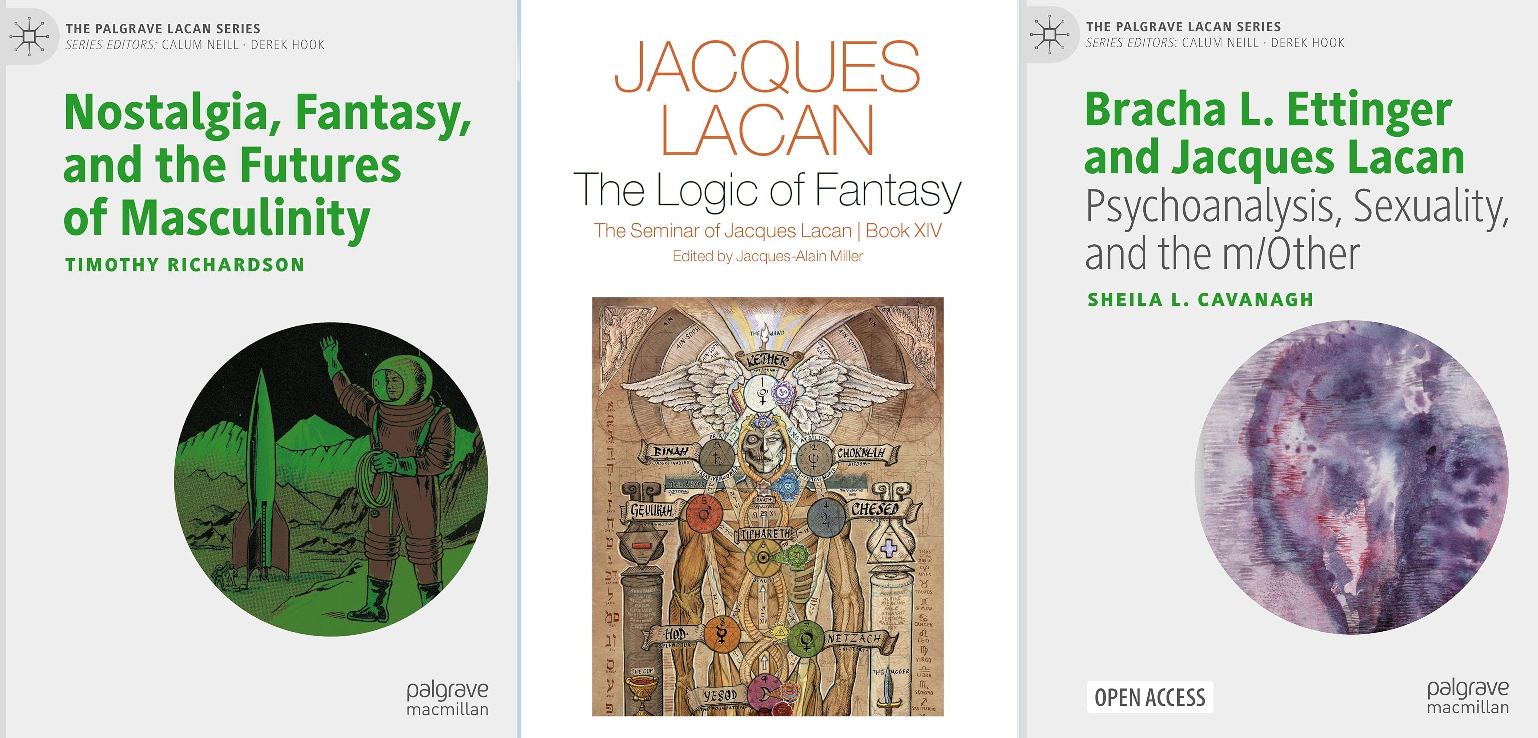
Beginning 16th September the Pakistan Psychoanalytic Society will start a five-part seminar series led by Azeen Khan PhD on ‘Fantasmatic Formations & The Symptom.’ This reading seminar will consider fantasy and the symptom in Freud’s cases of Dora and the Rat Man. Also running from September to April next year is a reading seminar on Lacan’s Seminar XIV, The Logic of Fantasy, meeting once a month. Lacan’s Seminar is newly-published in English, having been released earlier this summer from Polity.
Jason Childs and Derek Hook have announced two upcoming courses as part of their new venture, The Analytic Forum. The first, Psychoanalysis and Racism: Fanon with Lacan, runs Oct-Dec and will question whether psychoanalysis has done enough to understand racism and the colonial legacies that continue to shape contemporary society. The second, An Introduction to Freudian-Lacanian Psychoanalysis, begins next April and explores psychoanalysis through the work of Freud and Lacan, as well as some of the most influential Lacanians working today. Both will be delivered online via Zoom. Enrolment is open to all. Prior knowledge of psychoanalytic concepts and the relevant literature may be helpful, but is not required.
Lastly, a date of 29th-30th May 2027 has been set for the next NLS Congress, which will be held in Paris. The theme will be ‘Fantasmatic Scenarios’ and is organised under the direction of Éric Zuliani. More details are to follow but the argument for the theme, penned by Zuliani, is now published here (link downloads the PDF). NLS schools and affiliated groups will be organising events and study series on this theme towards the conference over the coming year. In time, more information will be added on the NLS site as well.
New Videos and Podcasts
The Rendering Unconscious podcast, hosted by Dr. Vanessa Sinclair, welcomed Luca Di Gregorio last month to discuss his recent book, Lacan in Italy: Clinic, Politics, Aesthetics which was published as part of the Palgrave Lacan Series last year. Di Gregorio gives an overview of the reception and dissemination of Lacan’s ideas in Italy, their take up by prominent Italian psychoanalysts such as Sergio Benvenuto and Massimo Recalcati practicing in the Lacanian orientation today, and Lacan’s own special relationship with the country he returned to often. Check out more content from the RU Center for Psychoanalysis, including courses, classes, and interviews, via Substack.
Joseph S. Reynoso joined Grégoire Pierre and Edgard Danielsen on their Discussions on Psychoanalysis podcast last month to talk about how sport can be understood through psychoanalysis and using Lacanian ideas. He discusses the ideas in his recent article, ‘We were robbed: the sport of stealing enjoyment’, which appeared in Psychoanalysis, Culture & Society earlier this summer. Reynoso also featured as the guest on the Pods Against Tomorrow podcast in July, discussing Scorsese’s Raging Bull with co-host Hugh Manon, who has published Lacanian-inspired work on film theory.
New Resources
Some great new translations on the Lacan page of Freud2Lacan.com this past month include particular rarities from Scilicet, the journal of the École Freudienne de Paris, founded by Lacan in 1968. Articles in this journal – other than those by Lacan himself – were published anonymously, but it has been possible to trace the authorship of several. Among these are: Jouissance et division by Chantal Maillet and Sylvie Sesé-Léger, translated by Richard G. Klein (number 237); an important paper on supervision by Jean Clavreul, D’un discours á l’autre l’institution dite du contrôle, translated by Richard G. Klein (number 246); The Core of the Gaze by J-F Chabaud, translated by Quinn Foerch (number 283); and Die Verpönung, L’opprobre (‘Opprobrium’ or ‘Disgrace’), by Lucien Israël, translated by Richard G. Klein (number 228). Other texts uploaded in August include Émile Benveniste’s lecture ‘Psychoanalysis and Linguistics’ from 1955, which was introduced by Lacan, and which has been restored thanks to careful editing by Mario Beira (number 107). Lastly, Lacan’s closing speech at the Strasbourg Congress on 13th October 1968, En guise de conclusion, published in Lettres de l’ecole Freudienne in 1970 is also new on the site (number 180), thanks to Anthony Chadwick’s translation.
Finally, LacanSeminars.com is a newly-launched tool for clinicians and academics to access Lacan’s work. Uniquely, it offers the integration of audio recordings for Seminar X, and Seminars XVII-XXVI. This is a great opportunity to hear Lacan’s delivery style, which may aide the understanding of how his Seminar worked. Side-by-side translations draw from the stenographer’s notes, the Staferla editions of the Seminars, and where available the audio recordings. The site aims to offer the researcher a resource that is faithful to Lacan’s speech as it was spoken and recorded. The audio transcription is provided by Cohere’s AI transcription service, and the stenographic transcripts are from the École lacanienne de psychanalyse’s website, as are the ALI/AFI versions. Use the drop-down at the top of the page to filter by Seminar.
Got news? Get in touch.
Sign up to the Newsletter to receive monthly updates on the latest Lacanian news