Sign up to the Newsletter to receive monthly updates on the latest Lacanian news
New Publications
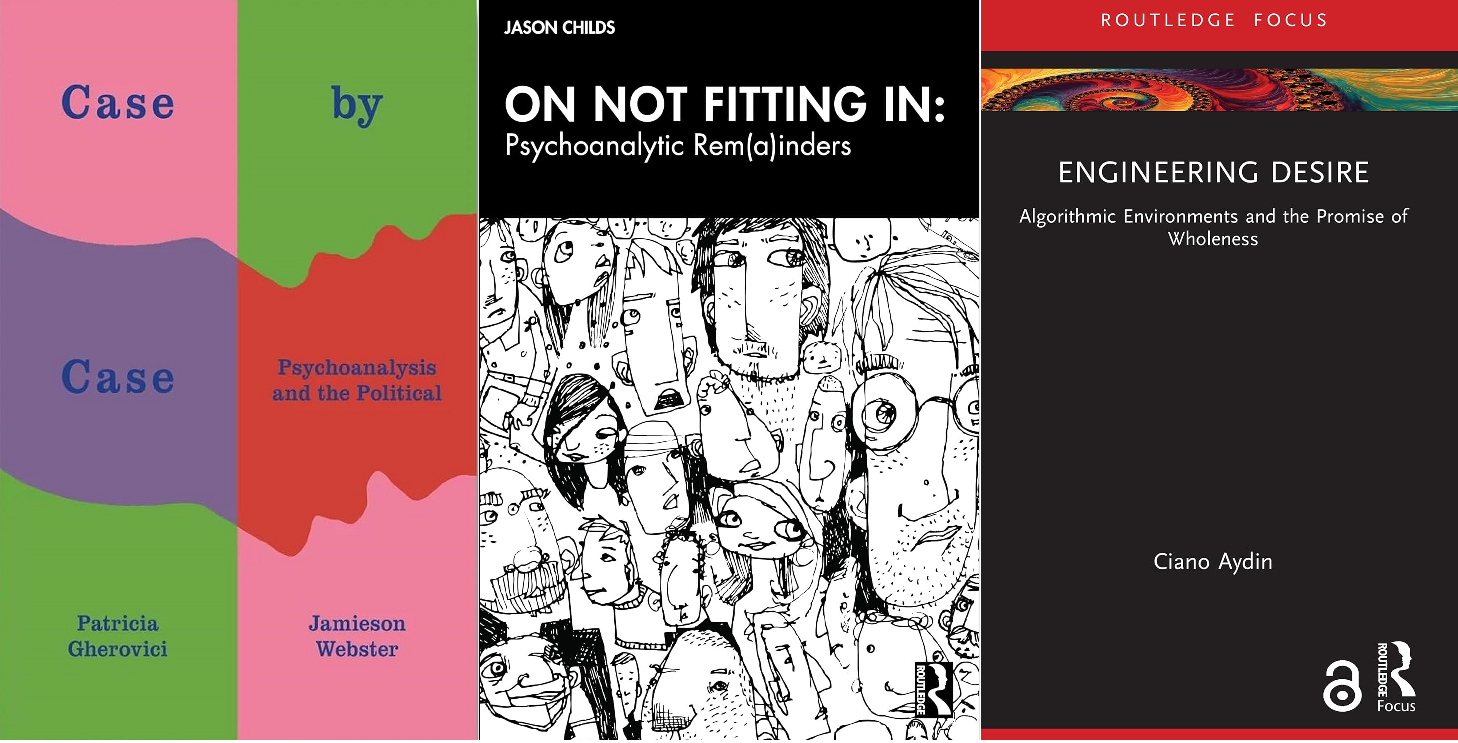
Case by Case: Psychoanalysis and the Political by Patricia Gherovici and Jamieson Webster examines the vexed relationship between psychoanalysis and politics through a sequence of case studies exploring the many ways in which the political enters the consulting room. They ask the question: must psychoanalysis remove itself from politics altogether in order to be effective? Or is it inherently political? Ranging from early cases confronting homosexuality and race to idiosyncratic analyses disentangling the legacies of state and colonial violence, the authors illuminate how the political shapes our relationships to power, normativity, and identity. The book is published with Mack Books, and is available now in the UK, and for pre-order in the US, where it is currently advertised to ship in November.
Engineering Desire: Algorithmic Environments and the Promise of Wholeness by Ciano Aydin is newly-published from Routledge, and is available under Open Access – meaning it can be downloaded for free either from the publisher, or to Kindle via Amazon. Hardcover copies are also available. Using Lacanian psychoanalysis to understand the appeal of technological innovations such as AI, digital platforms and algorithmic systems, Aydin argues that such technologies organise desire itself by offering recognition, orientation, certainty and the fantasy of wholeness. Taking Tinder as the paradigmatic example, he further proposes that the same systems which sustain such fantasies can also reveal the structure of desire itself.
On Not Fitting In: Psychoanalytic Rem(a)inders by Jason Childs will be published by Routledge on 5th November. The book offers a series of brief, thought-provoking essays on contemporary psychoanalytic theory and practice. Themes of desire, satisfaction, love, symptom and cure form the book’s interconnected sections. Alongside Freud and Lacan, Childs draws on the perspectives of contemporary analytic thinkers, combining them with meditations from philosophical and literary sources. An online workshop to mark the book’s publication, in which Childs will explore these and other fundamental psychoanalytic questions, will take place on 6th December.
From the journals, last month saw the arrival of the first issue of Surakh (سوراخ, “hole”), the journal of the Pakistan Psychoanalytic Society. No. 1, Formations, brings together texts by members of the Society, guest contributions, responses to the 2026 Congress of the New Lacanian School, and a systematic review of psychoanalysis in Pakistan. Additionally, a recording of the Pakistan Society’s recent event, ‘Question of the Society’, is also available on YouTube.
Upcoming Events
On Sat 7th November, the Lacanian Forum of Washington D.C., in cooperation with the New Washington School of Psychiatry, will continue its series ‘Inside the Lacanian Clinic’ with Alon Yaffe’s talk titled, ‘A symptom with no complaint.’ In contemporary culture, the notion of “well-being” is often translated into the ideal of zero symptomatology, an ideal which powerful chemical agents promise to guarantee. Demands for numbness, ignorance, and instant gratification are among the consequences. In this Seminar, Alon Yaffe, psychoanalyst and scholar, will focus on Lacan’s idea of the symptom as the essential residue of a treatment, the singular and valuable way for a subject to live life when knowledge the Other proves lacking.
Beginning on Sat 7th Nov, the Lacan Circle of Australia and the Melbourne School of Continental Philosophy will begin a series of four seminars on Marxism and Psychoanalysis: Towards a Critical Theory of the Subject & Society. Sessions will be on Zoom and recorded, for those not in Melbourne. The series will take up the long, complex and sometimes troubled relation between Marxism and psychoanalysis. This will be done through a psychoanalytic lens that is primarily Lacanian and will focus on themes such as materialism and the constitution of social bonds. The event is aimed at participants with varying levels of familiarity with the subject matter, and all are welcome to attend.
On 28th November, NLS Initiative Vancouver will hold a seminar as part of its Speaker Series working towards the theme of the 2027 NLS Congress, Fantasmatic Scenarios (more on which below). Dalila Arpin, of the ECF-WAP, will give a talk titled ‘Sadistic and Masochistic: Non-Symmetrical Fantasmatic Scenarios.’ Contact details to join this online seminar are here.
On Sun 13th Dec, the Pakistan Psychoanalytic Society will welcome Veronique Voruz for an online event on ‘The Analyst’s Discourse.’ As one of Lacan’s four discourses, the analyst’s discourse presents the possibility of a social bond unlike any other, with the analyst in the position not of mastery or all-knowing authority but as the cause of desire (object petit a) for the analysand. Voruz will discuss how one occupies this position, what is produced at the end of analysis by way of the analytic discourse, and what this entails for the psychoanalytic society. Véronique Voruz is a member of the École de la Cause Freudienne (ECF), the New Lacanian School (NLS), and the World Association of Psychoanalysis (WAP). She was Analyst of the School of the ECF from 2015-2018 and an inaugural managing editor of The Lacanian Review (TLR).
Beginning on 9th January, Stephanie Swales & Derek Hook will present a new course on ‘Perversion: Clinical and Theoretical Perspectives’ for The Analytic Forum. This online seminar series will run for 8 weeks until 27th February 2027. It will consider perversion first and foremost as a clinical structure, asking what conceptual resources Freudian and Lacanian psychoanalysis provide for recognising it, differentiating its forms, and working with it ethically in the clinic.
Between 10th-11th July 2027 the PIPOL 13 Congress will take place in Brussels. In preparation, the Gazette, a blog of sorts with a series of short contributions, began in October. On the PIPOL site the ‘Touchstones‘ section carries a number of brief reflections by analysts on the theme of the Congress, ‘To Say It All?’
New Videos and Podcasts
RU Center for Psychoanalysis welcomed Dr Dan Collins last month for a presentation on his translation of Lacan’s Seminar XXIV, the title of which he has translated as ‘Love is the Failure of the Unbewoops’. A recording is available here and the text of Collins’ translation is shared with subscribers. Following this, the RU Center is beginning a year-long study group on Seminar XXIV, beginning Saturday 21st November. The full schedule is here.
On YouTube, a recording of Jacques-Alain Miller’s address ‘The Incarnation of the Unconscious’, which was given at the WAP Congress on ‘The Speaking Body’ in Rio in 2016, is newly-available from the Miller TV series on Lacan Web Télévision’s channel. Subtitles are available in multiple languages, including English. In this talk, Miller considers the transformations in the status of the unconscious throughout Lacan’s teaching. Here he notes “the unconscious pertains to the speaking body” and opposes the common idea that “the body speaks.” The body as such does not speak, he argues; it is the vehicle, the instrument with which one speaks.
The Presentation of the Theme of the 2027 NLS Congress, by NLS President Eric Zuliani, is now available on YouTube. Audio translation in English has been uploaded by the NLS (go to settings and select the language from the audio track option if it does not automatically play.) The theme of this Congress will be ‘Fantasmatic Scenarios’ and it will take place in Paris on 29th-30th May next year. As is customary for the NLS, the theme will orientate the work towards the Congress in all of its Societies, Groups and Initiatives. Expect more details of events towards the Congress to follow in the coming months.
Derek Hook brought several new videos to his YouTube channel over the past month. As well as the continuation of his series on Substructures of Perversion and Fanon’s Black Skin, White Masks, he also interviews Darian Leader about the latter’s latest book, Autisms, and discusses with Patricia Gherovici and Jamieson Webster their new book Case by Case: Psychoanalysis and the Political.
New Resources
Over on Freud2Lacan.com, of the new translations in the past month several are of particular interest. Under the Autres Écrits section of the Lacan page (number 286) are now added translations by Richard G. Klein of Dissolution-era texts from 1980-1981, at the end of Lacan’s life. In January of 1980 Lacan suddenly announced the dissolution of his own school, the École freudienne de Paris (EFP), which he founded in 1964. The text of the ‘Letter of Dissolution’ (which is available under the Autres Écrits section) is followed by three newly-translated texts added in the last month. Firstly, in February of 1980, Lacan penned the Carton aux Mille, the cardboard notice handed out to the thousand or so followers who wrote to him to express their support, in which Lacan announces to them the founding of La Cause freudienne. In July that year, Lacan gave a short talk at the Maison de la Chimie following the vote on the dissolution, which is translated on the site as Petit discours à la Maison de la chimie. After this, Lettre de convocation à un forum, dated 26th January 1981, announces the convening of a Forum “where everything will be open for debate – without my presence”, and Lacan names those in whom he puts his trust to oversee this. Translations of all three are now available on the Lacan page. Separately, there are three new translations of texts from the journal Scilicet (vol 5) in 1973: Les lieux du réel (Places of the Real, number 216), Les lieux de l’impossible (Places of the Impossible, number 217), and Du terminable dans un cure analytique avec un enfant (On the Terminable in an Analytic Treatment with a Child, number 208) . Authorship of the journal’s articles was anonymous, unless Lacan chose to put his own name to them. It is likely the first piece was written by Lacan as an introduction to the texts that followed. Thanks to Anthony Chadwick for translating these three texts. Lastly, newly-uploaded is a translation of a text on the Borromean knot by Charles Melman, translated by Quinn Foerch – Le nœud borroméen n’offre pas de quoi se pendre (number 303). In this wide-ranging text, from 1988, Melman explores themes of death and existence, human conflict, suicide, and how the knot introduces a stability which can be maintained without the ideal of the father.
Got news? Get in touch.
Sign up to the Newsletter to receive monthly updates on the latest Lacanian news