Sign up to the Newsletter to receive monthly updates on the latest Lacanian news
New Publications
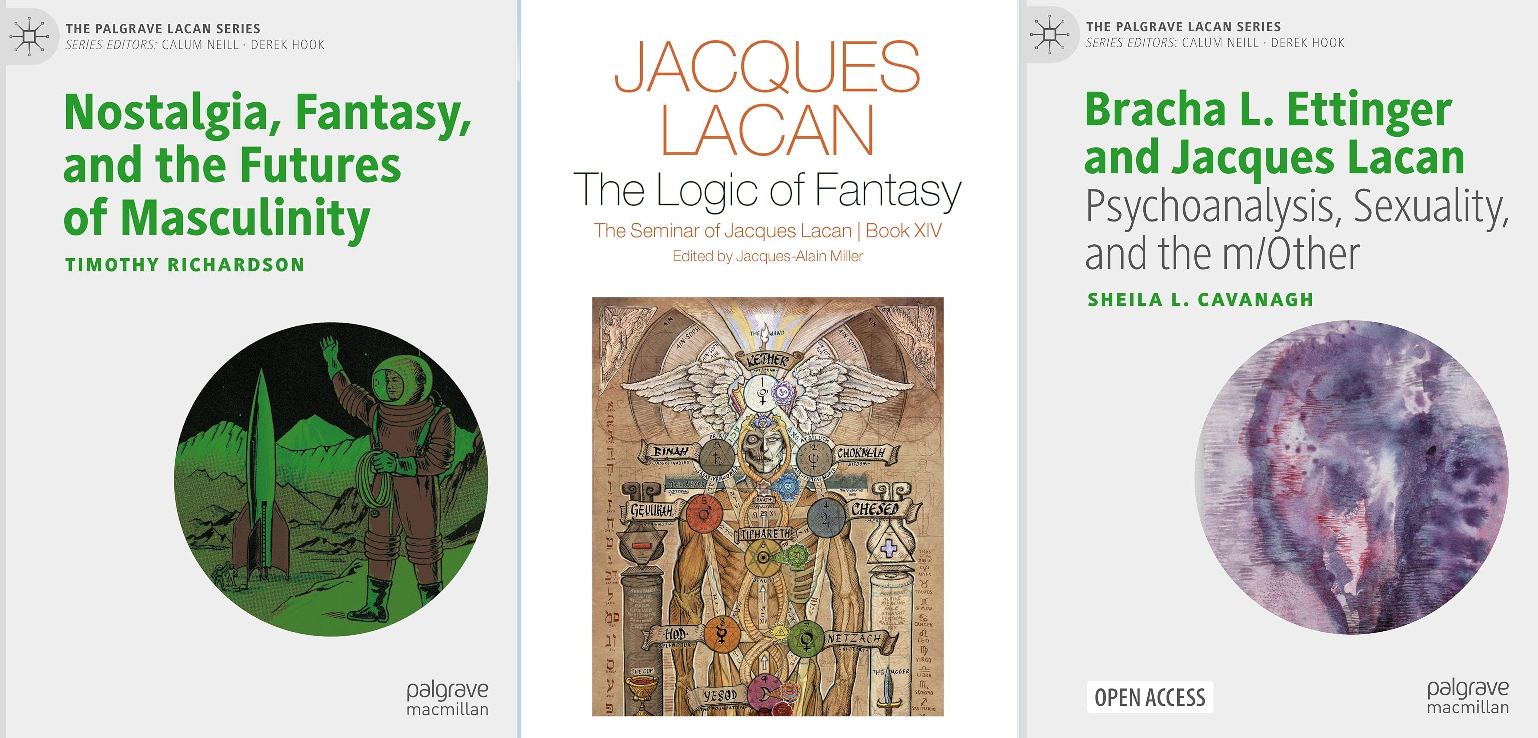
Nostalgia, Fantasy, and the Futures of Masculinity by Timothy Richardson was published last month as part of the Palgrave Lacan Series. Richardson uses Lacanian psychoanalysis to look at how contemporary masculinity is shaped by nostalgia-driven fantasies and how this affects our ability to imagine new futures. Proposing that capitalist discourse and masculine ideals are sustained by the recycling of familiar tropes in popular media, Richardson argues that such nostalgic scripts function to perpetuate cycles of consumption and naturalise gender norms. Lacanian understandings of concepts like fantasy, desire, and the capitalist discourse are employed as part of a critical intervention on debates around gender, temporality, and ideology.
Bracha L. Ettinger and Jacques Lacan by Sheila L. Cavanagh is also new from the Palgrave Lacan Series, and is available open access (meaning it is available for free with unlimited access). Download it on the publisher’s site here in PDF or EPUB form). Cavanagh sets out to demonstrate how Ettinger’s theory of the matrixial borderspace (a feminine-maternal sphere of sexuality and ethics) critiques and expands Lacan’s view of feminine sexuality. Ettinger’s work is put in its Lacanian context as a commentary on sexual difference and the place of the m/Other, while her modifications of Lacanian ideas – including the ‘weaning complex’, das Ding, the phallus, and the Real – are explored.
Lacan’s Seminar XIV, The Logic of Fantasy, has now been published in the US as of the end of June, following its April release elsewhere. This English translation by Adrian Price is edited by Jacques-Alain Miller and comes from Polity Press. The Seminar, from 1966-1967 is, like most of Lacan’s Seminars, deceptively-titled. Anyone seeking an answer to the question of what the ‘logic of fantasy’ is will be disappointed because – as Miller notes in his blurb – no account is ever given of it by Lacan and no single session of this Seminar is devoted to that question. What Lacan does say however is that the ‘logic of fantasy’ is to be understood as an “axiom”; like fantasy itself, the ‘logic of fantasy’ is never explicitly stated but can be constructed or inferred from the subject’s various positions and pronouncements. An axiom is true in the sense that it is able to be taken as a “pure convention”, as Lacan puts it. This new translation, from the middle period of Lacan’s work, is a must-have in the accelerated publication of Lacan’s Seminar in English.
4+One, the NLS cartels newsletter, published its 25th issue last month. It presents ten contributions from members of cartels, four of which were originally presented at Cartel Days in October last year. These short texts are published in English or French. Click here to download the PDF newsletter.
Upcoming Events
On Sat 4th July CFAR’s Annual Conference will take place in London and online via Zoom with this year’s topic being ADHD, ASD & Neurodiversity. Speakers and panellists will be Marie Couvert, Livia De Marco, Gwion Jones, and Darian Leader.
On Sat 11th July Domenico Cosenza will present online via Zoom for the Lacan Circle of Australia in a talk titled “An Appetite for the No-thing” – (Dis)ordered Eating and the Lacanian Orientation. Lacan, in his last reference to anorexia in 1974 curiously defined it as an action characterised by the fact of eating nothing. He underlined that this eating nothing was not a negative but an affirmative value. Cosenza will propose that anorexia, like the other “pathologies of excess” represent solutions that give the subject an anchoring, and that aim to become stable in a system of practices and rituals that are centred on the experience of jouissance. Cosenza is a psychoanalyst in Milan, and his his book A Lacanian Reading of Anorexia was published in 2023.
Also on Sat 11th July the RU Center’s Introduction to Psychoanalysis course will continue with this instalment covering Lacan’s life and work, and major Lacanian concepts. Recordings of the previous eight classes are available on the RU Center’s Substack, along with other psychoanalytically-themed talks and presentations. Especially worth watching from the past month is Michael McAndrew, Jen Braun, and Sean Carroll’s discussion on the state of psychoanalytic training in the US, and their efforts through their recent Frontiers of Psychoanalysis event to encourage different perspectives and discussion in the field. The RU Center’s schedule of upcoming events is also here.
Finally on Sat 11th July the Association Lacanienne Internationale (A.L.I.) will be holding a Study Day in English on Transference. The event is online via Zoom and is free. Papers will be presented by speakers from the US, France, and Ireland and conclude with a round table discussion on issues of transference in psychoanalysis in Turkey, with Turkish, French, and Dutch panellists.
On Sat 18th July, Dr. Luis Izcovich will be presenting on The Partner-sinthome for the Lacanian Forum of Washington DC, in cooperation with the New Washington School of Psychiatry, in a special event for its Inside the Lacanian Clinic series. The event is online via Zoom, starting at 11am ET. In this Seminar Izcovich “will show how the analyst can become a temporary partner to the patient’s own sinthome, defined as their creative solution to the difficulties of living. With this compass, the Seminar will approach the question of why analysis could be considered a therapeutic proposal that produces a new love and an unprecedented desire.”
Between August and December, Jason Childs and Derek Hook will be running an online seminar on Lacanian Diagnostic Structures and Clinical Technique. This seminar promises to offer clinicians and trainees a unique opportunity to move beyond an introductory or schematic comprehension of Lacanian diagnosis and toward actually implementing it in their work. Applications to join are open now. The seminar will be divided into four main modules, each running for five weeks and focused respectively on hysteria, obsession, perversion, and psychosis. Individual sessions, taught alternately by Derek Hook and Jason Childs, will involve sustained, accessible discussion of theoretical questions and detailed explorations of clinical literature, including Freud’s major case studies and contemporary Lacanian case studies. The concluding week of each module will consist of a workshop, led jointly by Hook and Childs, focused on clinical material provided by the participants or, where this is not available, by the instructors.
New Videos and Podcasts
The Lectures on Lacan series by Prof Dr Samuel McCormick concluded its summer series on Seminar XXII, R.S.I., in June and the recordings of all seven lectures in the series are available now, as podcasts on Substack or in video on YouTube, where you can also find the archive of all previous lecture series. Routledge will soon be publishing McCormick’s reading companion to Seminar XI, which is adapted from the Lectures on Lacan series, and will hopefully be the first in a new Routledge Guides to Lacan book series authored by McCormick.
On YouTube, Jacques-Alain Miller’s introduction to the theme of the 2028 World Association of Psychoanalysis conference, ‘The Impossible to Bear’, is now available. This title is taken from Lacan’s pronouncement that “The clinic is the real as the impossible to bear, and Miller’s comments reflect on how this impossible to bear constitutes a reason for entering analysis, the routine that underpins one’s reality known as the fundamental fantasy having been disturbed or torn with the irruption of an unrecognised real. English subtitles are available (via the cog wheel if they do not appear automatically). Miller’s remarks were delivered on 3rd May at the end of this year’s WAP Congress.
Derek Hook and John Dall’Aglio discuss Lacan on countertransference or: interpretation via the signifier on Hook’s YouTube channel last month, a conversation based on their recent joint paper in JAPA, ‘Interpretation by way of the signifier’, which gave a response to Gregory Rizzolo’s ‘The significance of the interpretant in the field of speech’ in the same journal. They respond to the charge that Lacanians do not take into account non-verbal aspects of the treatment by highlighting the ‘signifierness’ of non-verbal elements. In addition, they emphasise the performative (or non-verbal) dimension of Lacanian interpretations, and touch on topics such as the desire of the analyst, scansion, and interruption. They also discuss the imaginary, symbolic and real dimensions of the transference. Hook’s recent updates to his YouTube channel include presentations on Lacan’s view of hysteria, Lacan’s paper ‘The Neurotic’s Individual Myth’, and fantasy in Fanon and Lacan.
Donald Kunze last month presented ‘A Polythetic Method for Demonstrating Jacques Lacan’s Visual Thinking’ on his YouTube channel. Kunze considers Lacan’s incredible visual imagination, and the way that images represent what Lacan, following Jakobsen, called the ‘shifter’, changing with the changing position of the observer in reference to the world that an image represents. As examples Kunze compares Lacan’s interest in Velazquez’s Las Meninas, which the latter commented on in Seminar XIII, with Antonello da Messina’s St. Jerome in His Study, which was never commented on by Lacan. Kunze shows how Lacan used diagrams, drawings, photos of archaeological specimens, and famous paintings as study sites to find, within the “dilation” of the visual cone of vision, objects that played a double role as visible and “glyphic,” unsettling the visual order presumed by perspective, experience, and convention.
Thinking with AI and Lacan: a Lacanian perspective on AI in education, a presentation by Mandy Pierlejewski of Leeds Beckett University, considers the effect of AI use among students when subjectivity, thinking, and knowledge are outsourced to generative AI models. She proposes that this can be seen as a second mirror stage in which the subject becomes aware of itself as a fusion of human and machine, a cyborg self, with the AI established as an ideal I of knowledge, covering over the subject’s constitutive lack. Furthermore, she notes that generative AI functions to remove speech, with discussion among students being replaced with the responses of AI to a prompt – the possibility for intersubjectivity through interlocution, the transformational aspect of speech, therefore being foreclosed. But, as Lacan wrote in the Ecrits, “There is no cybernetic device imaginable that can turn his response into a reaction” (Ecrits, p.247).
New Resources
New updates and translations on Freud2Lacan.com last month include a translation of Wladimir Granoff’s 1955 paper ‘Psychoanalysis and Perversion’, with commentary by Lacan and others (number 101 on the Lacan page). The pair would later write a paper on fetishism together. This translation is by Richard G. Klein, edited by Mario L. Beira, with thanks to Dany Nobus for locating this paper as part of the work for his forthcoming biography of Lacan. Meanwhile, at the bottom of the homepage the ‘Names of Analysts’ list – a list of who analysed whom – has seen about 30 additions, especially those of Mexican analysts.
Got news? Get in touch.
Sign up to the Newsletter to receive monthly updates on the latest Lacanian news