Sign up to the Newsletter to receive monthly updates on the latest Lacanian news
New Publications
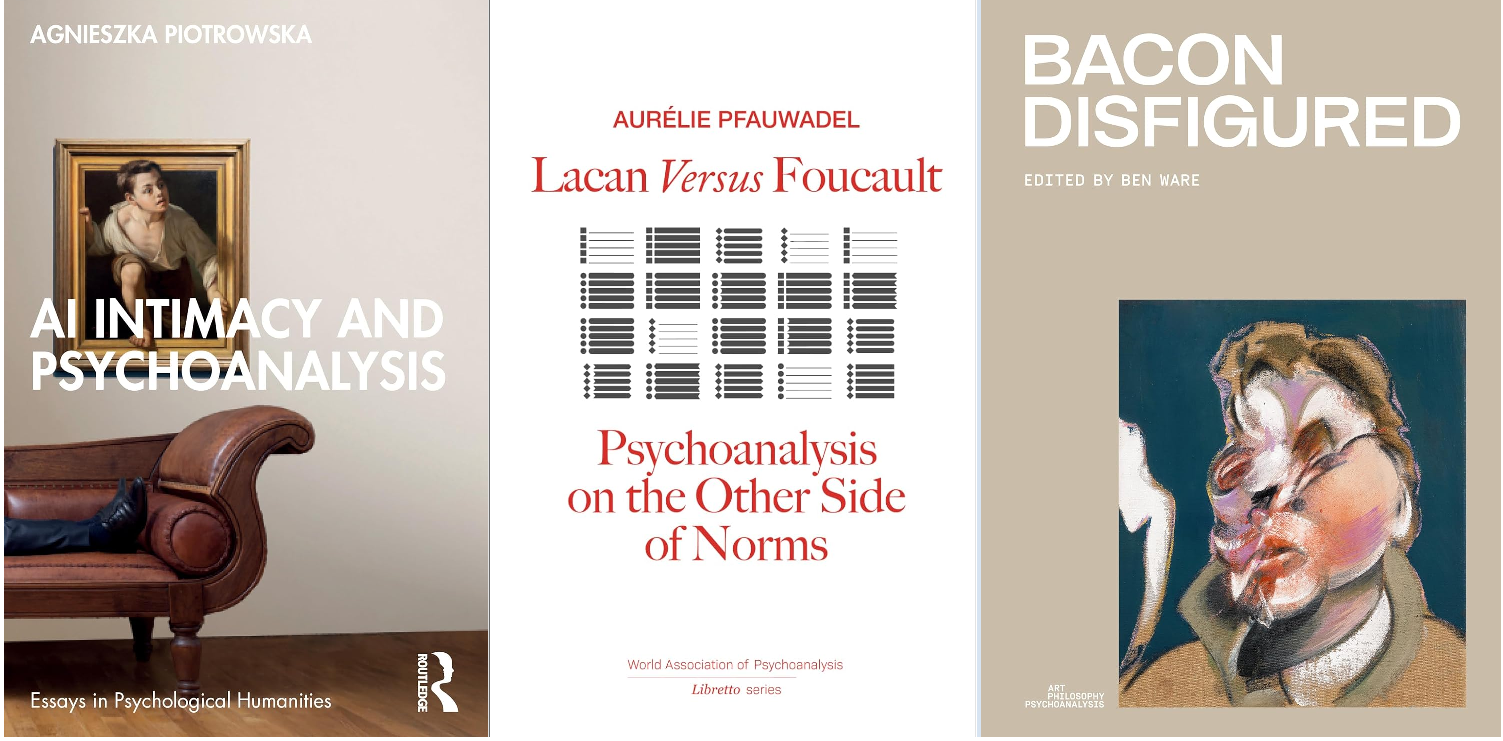
Lacan Versus Foucault: Psychoanalysis on the Other Side of Norms by Aurélie Pfauwadel has just been published by the World Association of Psychoanalysis’ Libretto series. It offers a response to Foucault’s critique of psychoanalysis in The Will to Knowledge (that psychoanalysis is inherently normalising), emphasising how Lacan’s project envisaged psychoanalysis as the precise opposite: a practice outside norms, on the “other side of normal”, as Pfauwadel writes. Aurélie Pfauwadel is a psychoanalyst, professor, doctor of philosophy, the Director of the Department of Psychoanalysis at Paris-8 Saint-Denis University, and a member of the École de la Cause freudienne and the World Association of Psychoanalysis. This translation from the French originally published in 2022 is by Janet Haney with John Haney, Max Maher, and Colin Wright.
A new collection of essays edited by Ben Ware, Bacon Disfigured, will appear on June 1st. Francis Bacon is one of the most important British painters of the twentieth century. In the volume, leading psychoanalytic theorists go to work on Bacon. They do to the artist what the artist does to his own painted figures: they disfigure and distort him, twisting and turning him into something new and previously unseen. Contributors include Joan Copjec, Aaron Schuster, Dany Nobus, Jamieson Webster, Ben Ware, and Alenka Zupancic. The essays shed new light not only on Bacon, but also on the stakes on psychoanalytic art criticism and its relation to our current political moment.
AI Intimacy and Psychoanalysis by Agnieszka Piotrowska was published by Routledge in May. The author uses Lacanian psychoanalysis alongside autoethnography and feminist theory to reflect on what she calls “techno-transference” in our (sometimes intimate) relationship with AI. The Winnicottian notion of transitional objects is also employed to conceive of how we relate to AI bots, with explanatory examples drawn from film and from the transcripts of human-machine conversations.
Paranoid Knowledge: Psychoanalysis and the Interpretation of Mad Writing by Alan Bristow was released in May as part of the Palgrave Lacan Series. Taking Schreber’s memoires and The Exegesis of Philip K. Dick (a selection of journal entries by the science fiction writer about his religious and visionary experiences), Bristow looks at how paranoid psychosis has been represented and used in forms of clinical practice and social critique. Lacan’s model of the sinthome from the latter’s later Seminars is employed and brought into dialogue with Mad Studies and critical mental health discourse to contend that psychosis be considered beyond pathology, as a way to understand broader psychosocial processes.
Lacanian Psychoanalytic Writings: The Littoral Word, edited by Megan Williams, is a collection of papers from the Freudian School of Melbourne which was published by Routledge in May. Based in clinical practice, and exploring themes of madness, hysteria, sexuality, and language, this volume contains important work by Jean Allouch, Christian Fierens and members of the Freudian School of Melbourne.
Among the journals, Miguel Gutiérrez-Peláez’s article ‘The symbol as a sinthome in Aby Warburg’ in the latest volume of Psychoanalysis, Culture & Society is highly recommended. It tells the fascinating story of Aby Warburg, a renowned art historian of his time who was treated in the Bellevue sanatorium under Ludwig Binswanger in the 1920s. Though Binswanger was one of the most respected psychiatrists of his age, and was in regular correspondence with Freud, it was Warburg’s disciple and co-worker Fritz Saxl whose influence Gutiérrez-Peláez focuses on in thinking about what was key to Warburg’s recovery process. Through an analysis of the clinical records and letters of the time, Gutiérrez-Peláez retraces Saxl’s role in helping Warburg develop restitutive practices which Lacan, his late work, would call sinthomes. Gutiérrez-Peláez’s paper presents a compelling story and a great lesson in practice. It is available to read open access via the link above.
The latest volume of Middle Voices, the journal of the Department of Psychology at Duquesne University, contains a range of fascinating papers on psychosis (Volume 3, Issue 2, 2026). Contributors come from Duquesne and other institutions worldwide, and articles discuss technical and theoretical issues that range from working with schizophrenia, the handling of dreams in psychosis, the ethics of residential treatment, and Lacan’s conceptualisation of elementary phenomena at the onset of psychosis.
The Lacanian Review Online is now available to access on the NLS site, with all published content since its 2015 inception included. LRO is a free, electronic newsletter in English which publishes contributions addressing the pressing questions of the time. The work of the LRO will resume under a new format later in 2026.
For Granta magazine, Ardian Vehbiu writes about ‘Lacan in Tirana’, an account of Lacan’s interest in Albania following his visit there in 1973 where he met the author’s father, Lacan’s only Albanian student. Lacan’s trip was cut short by the tragic death of his eldest daughter, and the following year Albania’s socialist regime under Enver Hoxha cracked down on Freudian and psychoanalytic ideas, believing them to be too ideologically liberal for the Soviet-aligned state. Vehbiu’s piece is a beautifully-written history of his father’s clinical work and the inspiration it took from Lacan’s teaching. It is also a precious insight into how novel and innovative practices of psychotherapy can develop under repressive conditions.
For Cultured magazine, Lacanian analyst Jamieson Webster discusses aphantasia (the inability to voluntarily create mental images in one’s mind’s eye) with Larissa MacFarquhar. In ‘What Not Having Mental Imagery Implies for Psychoanalysis, Trauma, and Our Sense of Self’ they discuss the relevance of Freud’s ideas on trauma, representation, images, memories, and mourning for this little-understood phenomenon.
On Substack, Darian Leader teases his forthcoming book on autism with a piece titled ‘Misreading the Child’, on how children’s behaviour can tell us about the ways that experiences of pain are encrypted. Leader also penned a post on ‘Potty Training’ in May showing how the child expresses choice and autonomy in the face of its caregivers’ demands. Meanwhile, Slavoj Zizek offers the text of his talk on ‘Why Artificial Intelligence is not a Subject’, which he presented at a conference in Munich earlier in the month, and makes available for free in full. And lastly, Ira Israel proposes ’10 Reasons Why the Lacan Bros Cannot Comprehend Lacan’ in a provocative post that has attracted some attention in the past month.
Upcoming Events
On Mon 1st June, The Site for Contemporary Psychoanalysis will be hosting Owen Hewitson (yours truly) for a talk on Unconscious Generational Transmission – A Story Beyond Trauma? The event is online and will begin at 7:30pm UK time (GMT+1). Then a couple of weeks later, on Sun 14th June, Ben Hooson will present for the Site on Lacan and Wittgenstein. This workshop will be in-person only, held in London.
On Sat 6th-Sun 7th June, a conference ‘On the Discontents of Patients and Clinicians in Psychiatry Today: What Psychoanalysis Can Offer’ will be held in-person in New York and on Zoom. It is the Second International Meeting of the Psychoanalysis in Psychiatry Section (PIP) of the World Psychiatric Association (WPA), in collaboration with Après-Coup Psychoanalytic Association (NYC). Register here.
On 7th June, Lacan Toronto will be welcoming Angelo Villa to present on ‘Notes on Child Psychoanalysis Today’. Lionel Bailly will also be presenting for the group on 21st June. Both events are free and open to all, and run 2:30pm-4pm ET. Just email tejpalajji @ gmail.com to request the Zoom link.
The Lacan Circle of Australia has just launched its webinar series on ‘Ordinary Psychosis & Classical Psychiatry’, presented by Jonathan Redmond. The series is online and recorded, so the first session which took place on 30th May can be caught up on before the others. The series runs on Saturdays till 20th June. Meanwhile the group’s series on ‘The Lacanian Object’, presented by Serena Smith, will conclude on Tues 9th June – again all sessions are recorded and available to participants.
A reminder that the 2026 NLS Congress will take place in the next month, on 27th-28th June in Paris, and registration is still possible with reduced rates for those under 28. The theme this year is ‘Varity – Variations of Truth in Psychoanalysis’. The conference site has full details, preparatory texts, and commentary in the form of contributions by cartel members who have been working on the theme. The Congress will be bilingual, in English and French. As a preview, a presentation of the Congress by Patricia Bosquin-Caroz, President of the NLS, is available on YouTube with English subtitles.
On Sat 4th July, the Race & Culture Committee at the Guild of Psychotherapists will be holding the latest in its series of seminars on Decolonising Psychoanalysis. In this online seminar, ‘Everyday Racism and the Legacy of Colonialism’, Ivan Ward analyses the psycho-political effects of racist assumptions that are a continuing legacy of colonialism. A recording of the seminar will be available to ticket holders for a full year after the event.
Looking further ahead as dates for the diary, the EuroFederation of Psychoanalysis has announced details of the next PIPOL 13 conference. It will take place in Brussels on 10th and 11th July 2027, with the title ‘To Say It All?’ [Tout dire?] The conference will be multi-lingual (in French, English, Spanish, Italian). Sign up to receive future updates by email here.
Finally among upcoming events, the World Association of Psychoanalysis has just announced its 16th Congress, which will take place in Paris in April 2028 under the title ‘The Impossible to Bear.’ No precise dates or further information has yet been announced – watch this space.
New Videos and Podcasts
The new podcast series from Prof. Dr Samuel McCormick’s Lectures on Lacan tackles Lacan’s Seminar XXII, R.S.I., and episodes 1 and 2 from May are already available to listen to on Substack. McCormick also sat down last month with Neil Gorman for an episode of the latter’s podcast, The Speaking Body, where he discusses the Lectures on Lacan project and psychoanalysis more generally. Listen here.
Psychoanalyst Judith Gurewich was interviewed for the Hermitix Podcast last month (available on YouTube here). She discusses her analytic formation and what it means to put pain and suffering “on the front line” in working with Lacan’s ideas. She also discusses her work as the Director of the Lacan Seminar at Harvard, and as the publisher of Other Press, a position she has held since 2002.
Darian Leader’s lecture on ‘Freud and Neurodiversity’, given as the 53rd Sigmund Freud Lecture at the Freud Museum in Vienna, is now on YouTube. Leader traces the ways in which, since Freud, pioneering analysts and researchers such as Margaret Mahler investigated the problem of autism, focusing on how the child responds to experiences in its own body, in dialogue and in synchrony with the mother. Leader asks, what would Freud have made of the contemporary concept of neurodiversity and the diagnostic debates around it? With many years of experience in paediatric neurology, how might he have approached the question of autism and the autistic spectrum? Leader’s book, Autisms, will be released in September and is available to pre-order now.
On YouTube, Leslie Chapman presents for Lacan In Scotland on ‘A Lacanian Clinic of Trauma’, the subject of his PhD thesis and his recent book. Discussing the difficulties in models of trauma which suppose an inaugural event, Chapman proposes that the subject is continually traumatised by the jouissance of the drive (which he refers to as “drive-jouissance”) emanating from a symbolic universe from which the subject will perpetually attempt to scrape a surplus jouissance. His thesis which follows from this is that trauma (or what he calls the “wounds of life”) represent an irruption of the Real into the subject’s Symbolic-Imaginary, with analysis aiming to provide space for the subject’s construction of a new sinthome allowing them to engage with the Real of trauma.
Also on YouTube, Derek Hook introduces Lacan’s ideas on logical time in two videos from last month explaining Lacan’s tricky 1945 paper found in the Ecrits as ‘Logical Time and the Assertion of Anticipated Certainty.’ Check out part 1 and part 2 and the rest of his channel’s videos.
New Resources
New translations and rare texts have been added to the treasure trove on the Lacan page of Freud2Lacan.com over the last month. Firstly (number 41 on the page) is Henri Ellenberger’s summary of Lacan’s doctoral thesis (which Ellenberger prepared in 1953 for Karl Menninger). The text comes courtesy of Dany Nobus. Ellenberger was evidently impressed by Lacan, reporting that, “It is difficult to give an account of this remarkable book: actually, it is not only a complete monograph about paranoia, but almost a textbook of psychopathology.” This is high praise indeed coming from the author of one of the greatest books on the history of the psychiatry and a must-read for anyone interested in psychoanalysis, his monumental The Discovery of the Unconscious, published in 1970. Secondly, a previously unknown text by Lacan, ‘The Silence of the Analysed’ [Le silence de l’analysé] (number 144) which Lacan delivered as an intervention at a Journées event, in response to a paper of the same name by Laplanche and Valabrega, in March 1960, concurrent with Lacan’s Seminar VII on The Ethics of Psychoanalysis. Thanks to Anthony Chadwick for the translation, Richard G. Klein for the editorship, and Dany Nobus for the discovery of this text. Thirdly is Quinn Foerch’s translation of Charles Melman’s text ‘Is Science a Fantasy’ (number 276), in which Melman explores various philosophical and scientific challenges in psychiatry, Freud’s conception of the unconscious, and Lacan’s later proposal that the unconscious be thought of as a formal, mathematical system. This is one of several Melman texts that are available on the Lacan page, including Melman’s ‘The Man Without Gravity’, (number 281) also translated by Quinn Foerch.
Got news? Get in touch.
Sign up to the Newsletter to receive monthly updates on the latest Lacanian news


