Sign up to the Newsletter to receive monthly updates on the latest Lacanian news
New Publications
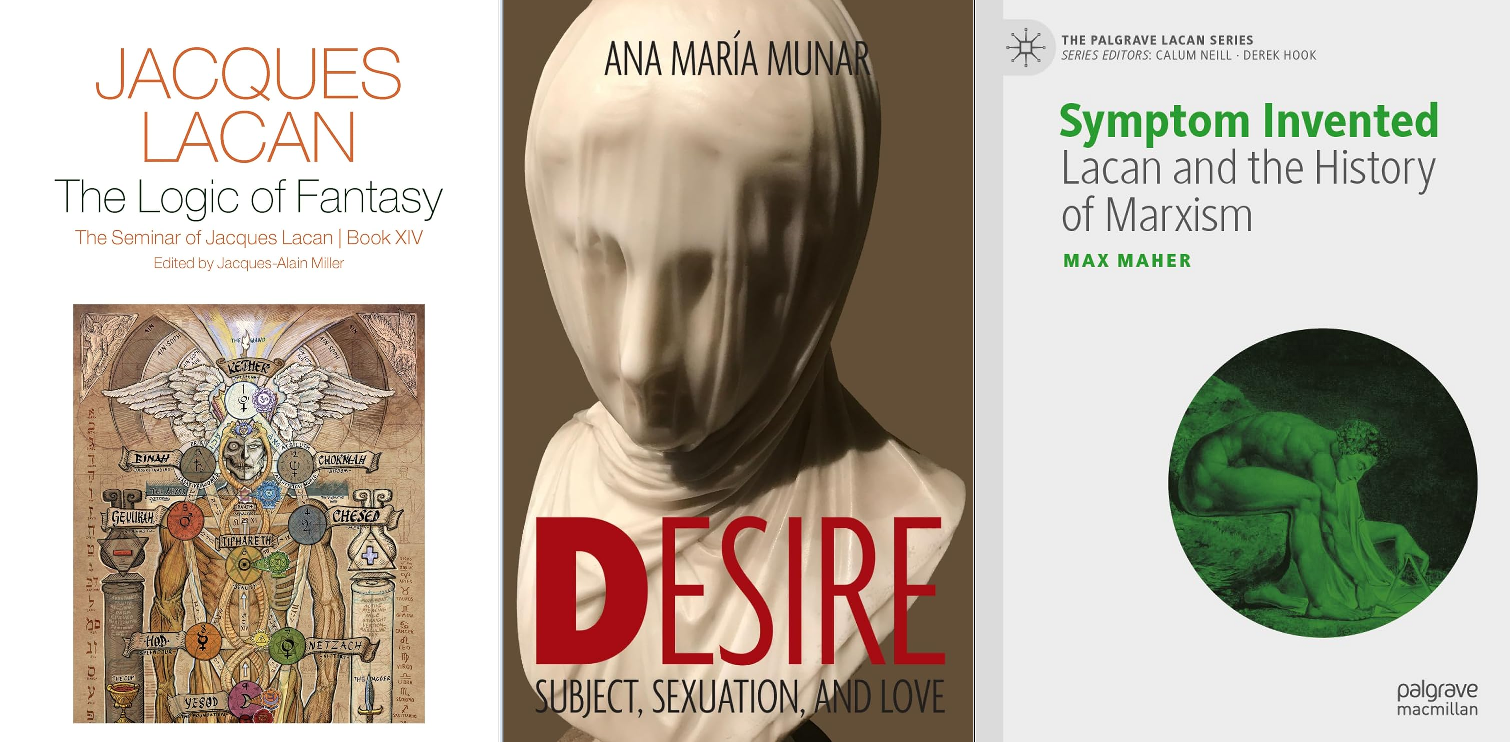
Lacan’s Seminar XIV, The Logic of Fantasy, was published by Polity last month, with English translation by Adrian Price and under the editorship of Jacques-Alain Miller. Currently it is available to buy now on Amazon UK, though in the US it is listed as a June release by Amazon, and by the publishers, so available only for pre-order. As with most of Lacan’s Seminars, the title is deceptive, and those seeking an explanation of what the ‘logic of fantasy’ is will be disappointed. As Miller notes in his blurb, no single session of this Seminar is devoted to that question, and no account is ever given of it by Lacan. Instead, the ‘logic of fantasy’ is to be understood as an “axiom”; like fantasy itself, the ‘logic of fantasy’ is never explicitly stated but can be constructed or inferred from the various positions and pronouncements therein. Fantasy has the role of what in this Seminar Lacan calls “truth-meaning.” An axiom is true in the sense that it is able to be taken as a “pure convention” so that, as Lacan says at the end of this Seminar, “what you have to do is to find in each structure a way to define the laws of transformation which guarantee for this fantasy, in the deduction of the statements of unconscious discourse, the place of an axiom.”* Much else is said besides about fantasy in this Seminar, making this text a vital addition to the collection of Lacan’s Seminars in English.
Relatedly, the release of the English translation of Lacan’s Seminar XV, The Psychoanalytic Act, has been announced for October. Like Seminar XIV it is translated by Adrian Price from the French edited by Jacques-Alain Miller. It is available to pre-order now via the Amazon site in the UK, or keep an eye on the publisher Polity‘s website for a pre-order option outside of the UK.
Desire: Subject, Sexuation, and Love by Ana María Munar is out now from Punctum Books. It is described as a work of gratitude to the Lacanian tradition and feminist philosophy. The book engages with Lacanian theories of subjectification and sexuation, while also drawing on literature, art, and popular culture – particularly The Little Mermaid – to explore the complex relations between desire, love, and subjectivity. It also combines conceptual analysis with experimental writing. The book is open access and freely available online via the link above.
Symptom Invented: Lacan and the History of Marxism by Max Maher was published at the end of April as part of the Palgrave Lacan Series. It looks at how Lacan’s thought reconceives the Marxist tradition and its politics, and likewise how psychoanalysis can be re-read through the Marxist movement. Arguing that the two share many of the same questions and respond to many of the same impasses, Maher surveys Lacan’s interventions and considers them in the light of contributions made by the philosophers of the Ljubljana School over the last 30 years, as well as the earlier French Marxists who were Lacan’s contemporaries.
Queer Psychoanalysis: Minor Clinic and Deconstruction of Gender by Fabrice Bourlez was released in April by Routledge. It examines the critiques of queer theory on psychoanalysis and what dialogue is possible between the two fields, what ethics can be brought out of this, and how psychoanalysis can be better able to respond to the full spectrum of subjectivity as it presents today. Bourlez looks at how psychoanalysis has historically conceived the “strange detours each and every subject takes through the heteronormative straits of what is usually taken to be their ‘development'”, asking how we can both reject a restrictive and adaptive mode of analytic thinking about sex and gender, while at the same time avoid a universalising or essentialising model of subjectivity.
Among the journals, a new volume of the journal Scilicet from the World Association of Psychoanalysis was published to mark the start of the organisation’s XVth Congress on the theme ‘There is no Sexual Relation.’ With more than a hundred contributions by Lacanian psychoanalysts worldwide, these texts represent the product of work in cartels from within the various Schools of the WAP. Jacques-Alain Miller’s opening text provides a theoretical and clinical frame for the volume, and for the Congress itself (which is underway at time of writing, in early May).
On Substack last month psychoanalyst Robert Samuels looks at Lacan’s Critique of American Ego Psychology and Ideology in his article about the post-war transformations of psychoanalysis in the US, the context in which Lacan began his Seminar and his own project of the ‘Return to Freud.’ In another post, Samuels considers Freud, Lacan, the Death Drive, and AI, arguing that AI offers us a way to relieve mental tension through the production of symbolic discourse which replaces animate life with the inanimate symbol. Samuels is the author of the thought-provoking 2021 book (Mis)Understanding Freud with Lacan, Zizek, and Neuroscience, which is recommended for its critiques of current readings of psychoanalysis by those within and outside the field.
Upcoming Events
Starting in August, Jason Childs and Derek Hook will be running an online seminar series on Lacanian Diagnostic Structures and Clinical Technique. The seminars will present Lacanian diagnostic categories in a way that offers clinicians and trainees an opportunity to move beyond an ‘introductory’ or schematic comprehension of Lacanian diagnosis and toward actually implementing it in their work. The seminar will be divided into four main modules, each running for five weeks and focused respectively on hysteria, obsession, perversion, and psychosis. Individual sessions, taught alternately by Derek Hook and Jason Childs, will involve sustained, accessible discussion of theoretical questions and detailed explorations of clinical literature, including Freud’s major case studies and contemporary Lacanian case studies. Applications are open now. Additionally, last month’s interview with the pair about their Introduction to Freudian-Lacanian Psychoanalysis course is also available on Rendering Unconscious.
On Saturday 9th May in London, Bruno de Halleux will be the guest speaker on the London Society of the New Lacanian School in the last instalment of its study series towards the NLS Congress on ‘Variations of Truth in Psychoanalysis.’ Halleux will present on ‘The Lying Truth’, with special reference to Lacan’s preface to the English edition of Seminar XI, which Jacques-Alain Miller has described as Lacan’s final word on the procedure known as the Pass.
Starting Saturday 30th May, the Lacan Circle’s Winter Webinar will begin on the topic of ‘Ordinary Psychosis & Classical Psychiatry: From Unitary Psychosis to Generalised Foreclosure.’ Jonathan Redmond will present over four Saturdays until 20th June, with events held online and recorded.
On 5th June, psychoanalyst Vicente Palomera from Barcelona will be speaking in Berlin for the NLS Initiative there on ‘What can I Expect from a (Lacanian) Psychoanalysis?’ The event is free and open to all.
Podcasts and Videos
On YouTube, the 2011 documentary Rendez-vous chez Lacan, made for French TV to commemorate the 30th anniversary of Lacan’s death, is now available in full. English subtitles are available (via the cog wheel in the bottom right) or, if you prefer, AI-generated dubbing into English. The hour-long documentary features interviews with Lacan’s former patients, students, colleagues, and family members. If you don’t already know about this documentary, you are in for a treat!
Also from 2011, courtesy of Lacan Web Television on YouTube, is an excerpt from Jacques-Alain Miller’s lecture marking the publication that year of three works commemorating the 30th anniversary of Lacan’s death (Lacan’s Seminar XIX, the short collection of Lacan’s intervention Talking to Brick Walls, and Miller’s own The Life of Lacan. In this clip, Miller comments on the phrase Y a de l’un, arguing for its centrality to Seminar XIX.
The excellent podcast Ordinary Unhappiness welcomed Loren Dent for a conversation on community psychoanalysis last month, in Episode 140: Psychoanalysis for the People feat. Loren Dent. In particular they discussed how a Lacanian perspective informs approaches to the provision of psychoanalysis within the community (support for low-fee or free clinics, the connection to historically marginalised groups, and the ethical practice of psychoanalysis within these contexts.) Dent discusses the ideas put forward by recent analytic writers on this topic, especially in Gabriel Tupinambá’s 2021 The Desire of Psychoanalysis. He also discusses the work of the Foundation for Community Psychoanalysis in advancing the values of community psychoanalysis.
Rendering Unconscious welcomed Christos Tombras on the podcast last month to discuss his new book, False Negatives: Tilted Takes on a World in Flux, a collection of philosophical essays examining truth, evidence, and meaning in the post-truth age. Remember to also check out the RU Center for Psychoanalysis and its Schedule of upcoming events for more, as well as its list of previous events under Classes.
Resources
Among the new translations last month on Freud2Lacan.com are some early and late texts by Lacan, respectively. ‘A Note on the Importance of Character Disorders in Vocational Guidance’ is a paper Lacan presented alongside the father of child psychiatry in France, Georges Heuyer, at a 1933 International Congress for the Protection of Children (translation by Anthony Chadwick, edited by Richard G. Klein, number 48 on the Lacan page). From later in his career, a translation of 1971’s ‘Talking to Brick Walls’, given at Sainte Anne hospital in Paris, is based on two different French source texts (number 192 on the Lacan page, bilingual prepared by Richard G. Klein); and from 1976, a paper which first appeared in the journal Scilicet vol 6/7, ‘Acting Out: Manifestations of a Response Production of the Unconscious’ (number 234, with translation by Quinn Foerch, edited by Richard G. Klein.) Additionally, a paper by Quinn Foerch on Lacan’s topology (‘Topology – Theory, Practice, Perspectives’, number 265 on the Lacan page) is well worth a read.
Finally, the excellent publishing house The Unconscious in Translation – which publishes translated work by Lacan’s contemporaries such as Jean Laplanche and JB Pontalis, as well as from newer authors inspired by these figures – currently has a Spring Sale running until 1st June, with all books buy one get one 50% off. Use code SPRING at the checkout.
*Translation from the earlier Gallagher translation, pending publication of the above Miller edition, translated by Adrian Price.
Got news? Get in touch.
Sign up to the Newsletter to receive monthly updates on the latest Lacanian news