Sign up to the Newsletter to receive monthly updates on the latest Lacanian news
New Publications
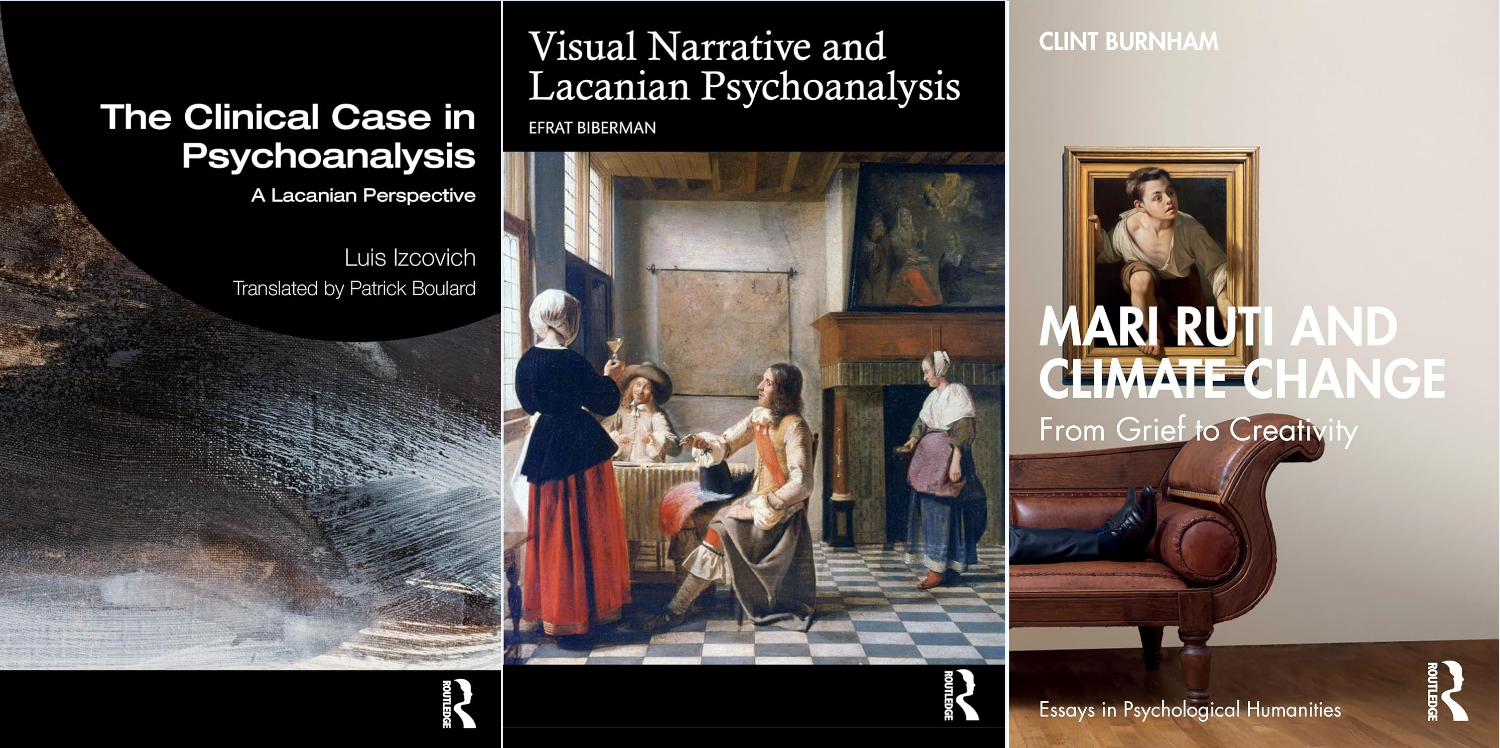
The Clinical Case in Psychoanalysis: A Lacanian Perspective by Luis Izcovich was released in English last month, translated by Patrick Boulard. Asking what makes a ‘case’ in psychoanalysis, Izcovich traces the responses to this question from Freud onwards, looking at how the idea of the ‘clinical vignette’ evolved, how analysts over time have approached the presentation of their clinical work, and the effect this can have on what goes on in the consulting room. Questions that are pertinent to the Lacanian approach specifically – such as what happens to the symptom at the end of analysis, and what use could be made with one’s singularity – are addressed in the book’s later chapters. A psychiatrist and psychoanalyst in Paris, Izcovich co-founded the EPFCL in France and teaches for the Collèges de clinique psychanalytique. Izcovich’s previous books include The Marks of a Psychoanalysis, which was translated into English in 2017.
Mari Ruti and Climate Change: From Grief to Creativity by Clint Burnham was published by Routledge last month. It uses Lacanian psychoanalysis, literary and art criticism alongside the work of the late philosopher and Lacanian scholar Mari Ruti to consider how we are implicated in the climate crisis today. The questions Burnham raises are often ethical (including in the Lacanian sense) – for instance on the ethics of opting-out and political centrism – and encompass meditations on grief, anger, and denial. Aesthetic questions are also posed, in particular through analysis of films in the ‘cli-fi’ genre, before broadening into reflections on sublimation and creativity. The book represents the culmination of Burnham’s thinking on climate that goes back to 2012. For a sample of Ruti’s work, The Singularity of Being: Lacan and the Immortal Within (2012) is recommended for offering a Lacanian model for thinking about a ‘subjectivity of the Real’ that avoids glamorising neither humanist ideals nor the death drive.
Visual Narrative and Lacanian Psychoanalysis by Efrat Biberman was published by Routledge last month, analysing narrativity in painting from a Freudian-Lacanian perspective. Biberman proposes a new way of thinking about painting which takes the viewer to be an active part in the creation of the visual narrative. Lacan’s work on topology is employed to re-think the extent to which there exists a boundary between the viewer and the painting they are viewing. Psychoanalytic understandings of the gaze, fantasy, and the position of the subject are considered in comparison to how such concepts are handled in art theory.
From the journals, Sheila Cavanagh’s paper ‘Jacques Lacan and The Ravishing of Lol Stein by Marguerite Duras’, appears in volume 30 of Angelaki, the Journal of the Theoretical Humanities, which came out last month. It is available online for free. It considers Lacan’s 1965 lecture, ‘Hommage fait à Marguerite Duras du ravissement de Lol v. Stein‘, which stems from the discussion Lacan gave to the Duras novel in his Seminar XII of that year (see in particular the session of 23rd June 1965).
For French speakers, Lacan’s Seminar XIII, The Object of Psychoanalysis [L’objet de la psychanalyse] will be released in French towards the end of January. It is available to pre-order now. With the text established by Jacques-Alain Miller, it is published by Seuil and Le Champ Freudien. An English translation is hopefully not far behind.
Upcoming Events
Lacan Tehran is offering a 12-week course on the Four Fundamental Concepts of Psychoanalysis, based on Lacan’s Seminar XI. A course brochure and more information in Farsi is here and here. If you are interested in undertaking a rigorous study of these fundamental concepts in Persian, email ravankavi@pm.me. Lacan Tehran is also hosting Dr. Luis Izcovich on Sunday 1st March 2026, 7.30 pm Tehran time. To register for that event, just send your name to ravankavi@pm.me. The poster and further details are here and here. Anyone interested is welcome. All of Lacan Tehran’s public seminars are bilingual, and this event is in English with concurrent Persian translation.
Starting on 10th January, CFAR will commence its spring term timetable of public seminars, available in-person in London or online via Zoom. As well as introductory lectures and a short course on repetition, talks will follow the theme begun last year – on autism, ADHD, and neurodiversity – with speakers from different disciplines and expertise in addition to the Lacanian field.
On 17th January the New Lacanian School will hold its ‘Question of the School’ event for this year on the topic ‘The Subject Supposed to Know in Supervision’. Registration is still open and the conference will be online, in both English and French. While Lacan preferred the term ‘super-audition’ to ‘supervision’ or the French equivalent, controle (see his 1975 Lecture on the Symptom at Columbia University), this conference will look at the ways that the different functions of supervision – case presentation, discussion, and the rectification of the practitioner’s position – could be considered today.
On January 20th, Mary Wild will be presenting on Lynchian Women in an event is organised by Rendering Unconscious Center for Psychoanalysis (more on RU below). Wild is the creator of the Projections lecture series at the Freud Museum London, applying psychoanalysis to film interpretation, and author of the just-published Psychoanalysing Horror Cinema from Routledge. In this talk (held on Lynch’s birthday) she takes a psychoanalytic deep dive into David Lynch’s heroines, interpreting his perplexing depictions of femininity via concepts including psychogenic fugue, the double, jouissance, the uncanny, and the sublime.
Starting on 24th January, Apres-Coup Psychoanalytic Association in New York will begin its events calendar for 2026. Events are in-person in NYC and online via Zoom. See the site via the link above for the full schedule.
On 25th January, the first International Seminar of the School of the Lacanian Field in English will be launched by the Forum of London, with its first speaker being Colette Soler presenting on ‘The Analytic Act: Conditions and Consequences’, with Darian Leader as discussant. The event is hybrid, taking place at University College London and online via Zoom, and is free. This is the first of six monthly presentations by AMEs from the School of Psychoanalysis of the International of the Forums of the Lacanian Field (IF-SPLF) which will run between January and June 2026. Future dates and speakers for the series are available on the Forum of London’s site.
On 31st January, Lacan/UK will present Salon Psychanalytique, an evening of conversation on the Effectiveness of Psychoanalysis, at the Freud Museum, London. A variety of therapeutic proposals are available to treat the subject’s discontent – what is the proposition of psychoanalysis, and what is its effectiveness? Talks from Tamara Dellutri and Dr Luis Izcovich, (who will be launching his new book mentioned above) will be followed by drinks & canapés. Register via the link above.
Starting on 14th March, the Lacan Circle of Australia is offering a new series of ten seminars Reading Lacan’s Seminar XVIII, On a Discourse That Might Not Be a Semblance. It is available in-person in Melbourne, or online, and sessions will be recorded. Presenters are Russell Grigg, David Ferraro, Kate Briggs, and Jonathan Redmond.
New Videos, Podcasts, and Resources
On Substack, Rendering Unconscious Center for Psychoanalysis offers a wealth of classes and conversations on psychoanalysis, hosted by Dr Vanessa Sinclair. Paid subscribers get access to the full archive, which includes an ongoing ‘Introduction to Psychoanalysis’ course; recordings of events with leading psychoanalytic theorists, practitioners, and those engaging psychoanalytic ideas from more diverse perspectives; and a four-part course on Sinclair’s book Scansion in Psychoanalysis and Art: The Cut in Creation (Routledge, 2021).
On YouTube, Derek Hook offers channel Members a new three-part series on Lacan’s 1949 paper, ‘The Neurotic’s Individual Myth’, the latter’s treatment of the case of Freud’s patient known as the ‘Rat Man’.
Donald Kunze’s latest YouTube videos continue to provide an excellent perspective on Lacan’s work on topology. Check out his three new videos – ‘Non-Orientation Matters! Ambiguity and the Other of the Perspective Hinge’, ‘The Psyche is Extended – but HOW?’, and ‘The Butterfly and the Circuit: Shibboleth for the Imaginary’ – which were published last month.
Initiative Toronto has uploaded a bunch of videos to YouTube in the past month, recordings from its events over the past 5 years since the COVID lockdowns. Some follow the themes of the WAP Congresses over that time – for instance, those from 2020 on dreams; others are on theoretical and clinical themes, including Veronique Voruz on the symptom, Marcelo Veras on bipolarity, and Fabian Fajnaks on the object a.
Finally, check out my own latest video – ‘What is Object a?’ – on YouTube here.
Got news? Get in touch.
Sign up to the Newsletter to receive monthly updates on the latest Lacanian news