Sign up to the Newsletter to receive monthly updates on the latest Lacanian news
New Publications
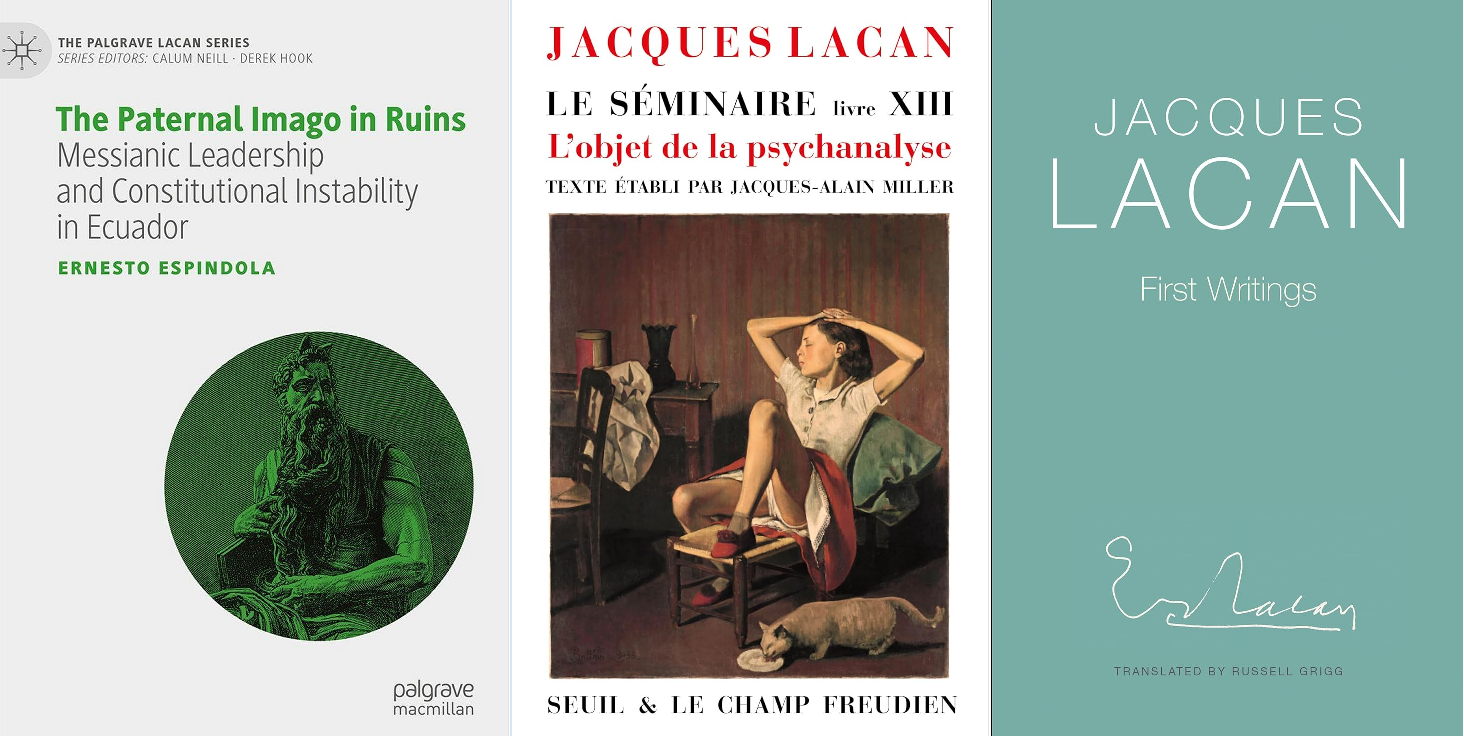
The Paternal Imago in Ruins: Messianic Leadership and Constitutional Instability in Ecuador by Ernesto Espindola was published in January, and uses a Lacanian discourse analysis together with an interpretation of Freud’s Moses and Monotheism to think about the psycho-political dynamics of postcolonial change. With a focus on constitutional instability in Ecuador’s history, Espindola analyses how affective investments in charismatic or authoritarian leaders are underpinned by heroic identification, the paternal imago, and the fantasy of national redemption. It is the latest title in Palgrave Macmillan’s Palgrave Lacan Series.
Lacan’s Seminar XIII, L’objet de la psychanalyse (The Object of Psychoanalysis) was published in France last month by Seuil and Le Champ Freudien. The text is established under the editorship of Jacques-Alain Miller and an authorised English translation is likely to follow soon. The publication of Lacan’s Seminar has increased in pace in France recently, with new Seminars released at the start of each year. 2023 brought us Seminar XIV (The Logic of Fantasy, the English translation of which is scheduled for June this year); 2024 saw Seminar XV (The Psychoanalytic Act); and 2025 began with Seminar XII (Crucial Problems for Psychoanalysis).
A longform review of Lacan’s First Writings, by Robert Boncardo and Christian R. Gelder, was recently published in the Sydney Review of Books. Titled ‘Where have all the pithiatics gone’, the authors trace Lacan’s journey as a young psychiatrist, working at a time where the Freudian understanding of hysteria as characterised by somatic conversion was being challenged by Babinski’s model of suggestibility under the name of ‘pithiatism’. They note how the presentations of the pithiatic patients Lacan saw in the late 1920s anticipated how Lacan understood paranoia by the early 1930s, in the period where Lacan’s interest started to turn from psychiatry to psychoanalysis. They also note how, far from being the maverick pioneer that he was later to gain a reputation as, the Lacan of the First Writings was “participating in the conventions of early twentieth-century psychiatry.” Boncardo and Gelder’s review is a great piece that soberly situates Lacan in the psychiatric context of his day. First Writings itself was published by Polity last year, translated by Russell Grigg.
Among the journals, you can now order a physical copy of Lamella #10 (in English), which contains the proceedings from the Reawakening Freud conference held in Copenhagen in January. A free digital version of Lamella #10 will be made fully available online at a later date. Physical copies of Lamella #9 are also available to order. Lamella #10 celebrates the 125th anniversary of Freud’s The Interpretation of Dreams, relating it to a wide range of topics, within and beyond the clinic. Inspired by Freud’s insights and method, the articles present analyses of ideology, literature, art, and even of Freud’s own dreams and writings. The volume includes contributions from Alenka Zupančič and Mladen Dolar. Order here.
pas tout is a new online journal for psychoanalysis, a space for writing at the crossroads of psychoanalysis, aesthetics, and cultural critique. Each month it features an essay, an interview, and a contribution of poetry or other aesthetic practice. It is open to submissions in English, German, or French. Subscribe to the newsletter via info@pas-tout.com and follow on Instagram at pastout_journal.
Upcoming Events
Starting 3rd February, in-person only in Melbourne, Russell Grigg will begin a new seminar series for the Lacan Circle of Australia on ‘Freud’s Cases and What They Can Teach Us.’ The five cases – Dora, the Rat Man, Schreber, the Wolf Man, Little Hans and the Young Homosexual Woman – will form the basis of a discussion of clinical issues in psychoanalysis, encompassing the commentary by Lacan, Miller and others, across five Tuesdays until early June.
On 7th February, Vanessa Sinclair’s Introduction to Psychoanalysis course continues as part of the program for the Rendering Unconscious Center for Psychoanalysis. This class will discuss the work of early student of Freud, Otto Rank, as well as early collaborator Sándor Ferenczi. It will also take a look at Freud’s paper on the Family Romance and his case studies, Little Hans and The Rat Man, all from 1909. Later this month Sinclair will also be speaking at the Freud Museum London, in-person on 25th February, on ‘Surreal Secrets of the Psyche: The Creative Zeitgeist of Psychoanalysis, Film and the Avant-Garde.’ The RU Center’s active program includes regular guest speakers including, on April 2nd, yours truly presenting on ‘Unconscious Generational Transmission: A Psychoanalytic Perspective.’
Beginning 10th February, Serena Smith will be leading a series on ‘The Lacanian Object’ for five seminars for Lacan Circle of Australia taking place in-person, online, and recorded. The course will consider Lacan’s comment that “man thinks with his object” (Seminar XI, p.62), and explore the invention of the objet a in Seminar X, and what came before this purely Lacanian idea.
On 18th February Leon Brenner will be speaking in London on ‘Navigating Transference in Psychosis’. This will be an in-person only event, hosted by the Site for Contemporary Psychoanalysis. From a Freudian and Lacanian perspective, Brenner will discuss psychotic transference as a distinct clinical configuration with its own logic, risks, and clinical demands.
Between February 27-28 Lacanian Compass will hold its Clinical Study Days 18 in Miami on ‘Misunderstanding in Sexuality.’ Registration is open here. Guest speakers will be Christiane Alberti, President of the World Association of Psychoanalysis, and Neus Carbonell.
Après-Coup Psychoanalytic Association’s events program continues throughout February with André Michels presenting ‘On Repetition: Lacan’s Contribution to Logic’ on Feb 7; Paola Mieli ‘On Hate and Love’ on Feb 14; and Erik Porge on ‘Barred Letters: $ or The Subject without Subjectivity’ on Feb 28. Each begins at 10am ET and take place in-person in NYC or online on Zoom. More details and link to register here.
Videos and Podcasts
Video of last month’s talk by Colette Soler on ‘The Analytic Act’ is now available on the Lacanian Forum of London’s site. She was joined by Darian Leader as the discussant for her talk. This was the first International Seminar of the School of the Lacanian Field in English, opening a series of six monthly presentations by AMEs (Analyst Members of the School) from the School of Psychoanalysis of the International of the Forums of the Lacanian Field (IF-SPLF) on the theme of ‘The Analytic Act: Conditions and Consequences.’ The additional five speakers, between February and June, will be Adriana Grosman from São Paulo, Dominique Fingermann from Montpellier, Anastasia Tzavidopoulou from Paris, Carolina Zaffore from Buenos Aires, and Leonardo Rodríguez from Melbourne. More details on the Forum site.
Stijn Vanheule was the guest of Vanessa Sinclair on the Rendering Unconscious podcast in January, speaking about his work critically examining the DSM and his resulting book Psychiatric Diagnosis Revisited (2018). Vanheule also discusses the integration of psychoanalysis into the clinical psychology program at Ghent, and his involvement in the four-volume Reading Lacan’s Ecrits project from Palgrave Macmillan.
Betty Milan was interviewed by Matthew Pieknik in January for the New Books in Psychoanalysis podcast. She discussed the 2023 English translation of her memoir of her analysis with Lacan, published in the collection Analyzed by Lacan, which also includes her play Goodbye Doctor, later adapted into the movie Adieu Lacan directed by Richard C. Ledes.
Parlêtre is a new podcast hosted by Neeshee Pandit and Andrew Flores exploring the theoretical and clinical intersections of Lacanian psychoanalysis through free-associative conversation. The inaugural episodes will discuss Lacan’s Ecrits text ‘The Function and Field of Speech and Language in Psychoanalysis’, with Episode 1 discussing the first section, in particular the distinction Lacan draws between full and empty speech. Subscribe on Spotify or YouTube.
Prof Dr Samuel McCormick’s Lectures on Lacan series continues, available on YouTube and podcast via Substack, with the current focus being Lacan’s 1974 lecture La Troisième, which Lacan presented just prior to beginning Seminar XXII, R.S.I. and in which he develops his idea of lalangue. Three episodes in January focused on La Troisième, with the next stop being Lacan’s Seminar XXIII, The Sinthome, beginning 13th February.
Translations and Resources
New updates on Freud2Lacan.com last month include a translation of André Albert’s piece in Scilicet 6/7, Sur le plaisir et la règle fondementale (number 213 on the Lacan page), and Lacan’s response to it (number 214). Both were presented at the Journées de l’EFP on June 14-15 1975. The English translation of Albert’s piece is by Anthony Chadwick and edited by Richard G. Klein. Quinn Foerch has also provided translations of Lacan’s handwritten notes to French philosopher Ferdinand Alquié penned in 1928 and 1938 (numbers 9, 10, and 65 on the Lacan page). Meanwhile, new on the homepage of Freud2Lacan.com is a ‘Chronology of the case of the Young Homosexual Woman’, providing a timeline of the life of Freud’s patient Margarethe Csonka up to the point of the publication of Freud’s 1920 paper on her, ‘The Psychogenesis of a Case of Homosexuality in a Woman.’ It also includes detail about Bertha Hermine Leonie von Puttkamer, the woman with whom Margarethe became fascinated, who appears as a significant character in the case. A recent book, Michal Shapira’s Sigmund Freud and his Patient Margarethe Csonka, tells Margarethe’s story more thoroughly.
Finally, Quinn Foerch’s translation of Charles Melman’s ‘New Psychic Economy’ is now available on Freud2Lacan.com. This translation encompasses Melman’s seminars in Brazil in 2002 on new clinical forms, and seminars on the subject of matriarchy given in Belgium in 1999 and Brazil in 2008 respectively. After his analysis with Lacan and the latter’s death, Melman co-founded the organisation that is today known as l’Association lacanienne internationale (ALI).
Got news? Get in touch.
Sign up to the Newsletter to receive monthly updates on the latest Lacanian news


