
The title of this short article will resonate with readers of the Écrits,

At the end of his twenty-fifth Seminar, The Moment to Conclude, Lacan makes a few remarks about what the end of a psychoanalysis looks like:
Analysis does not consist in being liberated of his or her symptoms, since it is like this that I wrote it: sinthome.
Analysis consists of what one knows of why one is entangled in it. It is produced by virtue of the fact that there is the symbolic. The symbolic is the language [le langage] we learn to speak and it leaves its traces. It leaves its traces and, by virtue of this, it leaves consequences which are none other than the sinthome, and analysis consists in giving an account of why one has these sinthomes.” (Seminar XXV, 10th January 1978, my translation.)
The imagery with which Lacan begins these remarks is interesting. We turn round, we turn round twice. A psychoanalysis involves telling the same story twice, perhaps three times, four, five times, revisiting the same experiences in our history again and again, exploring them from different angles.
The thread of speech goes round and round. And when we turn round and round we can get tangled in that thread. We cannot be free from something that entangles us, which is why Lacan goes on to say that we shouldn’t feel obliged to keep turning round.
What’s interesting about these remarks is that Lacan is saying something very different from the received wisdom that ‘talking helps’. Indeed, in this passage he goes on to say the opposite – a psychoanalysis is not about liberating you from your symptoms, from what’s troubling you. Instead, psychoanalysis helps you to make of these symptoms what he calls a sinthome.
So what is a sinthome?
At the simplest level, Lacan says that it’s another way of spelling ‘symptom’. The two are pronounced identically in French.
Gichin Funakoshi was Japanese, he lived on the Ryukyu Islands in present day Okinawa. In Japanese, different characters are pronounced identically, and a single character may have different pronunciations, depending on the context. The term ‘karate’ is an excellent example of this. Breaking it down, the term te means ‘hands’, but the term kara can be written with two very different characters, both of which are pronounced identically, as kara. One means ’empty’ and the other is a Chinese character referring to the Tang dynasty which can be translated as ‘Chinese’.
So, just like with ‘symptom’ and sinthome, we have two ways in which the term ‘karate’ can be written. Funakoshi’s achievement was not just to develop the shotokan style of karate, but to popularise the change in how karate was both written and thought about – from ‘Chinese hand’ to ‘empty hand’.
Karate is an ancient art the origin and history of which is obscure. But what is known is that it can be traced back to the Ryukyu Islands in the early 17th century. Around this time, the victorious invading army of the Satsuma clan promptly banned all weapons from the hands of the defeated islanders, forcing them to develop a form of self-defence that didn’t require armed combat. Hence the meaning of the term ’empty hands’, and the reason why – until Funakoshi popularised it in the early twentieth century – karate was banned so knowledge about it was passed down and practiced in secret.
The same elegant trick Lacan played in rewriting ‘symptom’ to sinthome Funakoshi played with rewriting ‘karate’ from ‘Chinese hand’ to ‘empty hand’. In both Lacan and Funakoshi’s move there is an act of re-writing, an orthography, a playing with the texture of signifiers. “Try playing around with spelling”, Lacan told an audience in Lyon in 1967, “it’s one way of dealing with ambiguities, and it’s not entirely pointless” (My Teaching
But if we return to the quote from Lacan that we started with we can see that the similarity between Funakoshi and Lacan goes deeper. The parallels are not just in their orthography but between the two arts that they practiced.
When we re-write something we tangle the signifier. But this is different from the kind of tangling Lacan suggests we get into when we turn round and round the threads of discourse talking about ourselves in a psychoanalysis. With the idea of the sinthome Lacan was trying to find a way to turn a tangle into a knot.
The beginner in karate will get themselves in a terrible tangle – limbs flailing, balance lost. But as they get better they will be able to find form in the tangle. They will move from a tangle to a knot.
What made Funakoshi a Lacanian before Lacan was the way he envisaged that karate could knot a tangle. The difference between a tangle and a knot is that things are intertwined in a different way. Under Funakoshi’s re-writing, ‘karate-do’ means ‘empty-handed Way’. Thus, karate becomes not just a martial art, but a ‘Way’, a way of living that knots what we can recognise as the Lacanian registers of the real, the imaginary and the symbolic. The aggression inherent to the imaginary register, the pangs of symbolic slights, the shock of the real in being thrown a punch in the face unawares – karate is a way of knotting the threads of these three registers.
Funakoshi was no stranger to the significance of the knot. On the very first page of his autobiography he starts by talking about the importance in his life of a particular kind of knot, the topknot, a masculine hairstyle widespread in Japan in the late nineteenth century. As part of a drive to modernisation, the Meiji government abolished the topknot when Funakoshi was young. The move faced great resistance in Okinawa, and great resistance by Funakoshi’s family. The medical school which he hoped to attend refused admission to students still sporting a topknot, but he kept it nonetheless, abandoning it only later when he started his new profession as a teacher. Thus it is that the first chapter of his autobiography is titled ‘Entering the Way; Losing a Topknot’. (Funakoshi, Karate-Do: My Way of Life
The kind of solution that Funakoshi saw in karate Lacan saw in the construction of a sinthome through the process of a psychoanalysis. The nature of these solutions are absolutely not superficial – they are ways of living for the subject. In his book Funakoshi doesn’t distinguish between the practice of karate in the dōjō and the lessons that he believes karate can teach outside it. A quick glance at a few of his ‘Twenty Principles’, his collected maxims on karate, is enough to make this clear – ‘Karate goes beyond the dōjō’; ‘Karate is a lifelong pursuit’; ‘Apply the way of karate to all things, therein lies its beauty’. (Funakoshi, The Twenty Guiding Principles of Karate.
For Lacan, to identify with the sinthome is to identify with that part of one’s symptom that cannot be untangled through the symbolic (for example, through lying on the couch talking to a psychoanalyst or a psychotherapist). The sinthome is a particular organisation of what Lacan calls jouissance, a kind of unmasterable enjoyment or excitation. The sinthome is a formulation that allows one to live with what cannot be assumed in the symptoms from which one suffers.
Like Funakoshi, Lacan has a particular knot in mind. With the Borromean knot that so fascinated him in his final years, Lacan was proposing an intertwining of the real, imaginary and symbolic registers that is bound by a fourth term – the knot of the sinthome. The theoretical obsession with topology that Lacan entertained at the end of his life, and that some find so baffling, was borne of a search for a practical solution to a universal problem – how can psychoanalysis make the suffering inherent in human life more bearable?
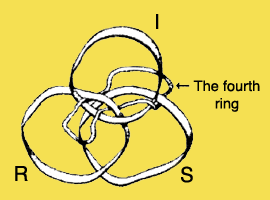
Image credit: http://www.lacan.com/semofmemf.htm
This article has been as much about a guy who did karate in the 1920s as it has been about Lacan. Why choose this character Gichin Funakoshi to talk about psychoanalysis?
Lacan once said, “Take a leaf out of my book – don’t imitate me”. Lacan was unashamedly interdisciplinary, perhaps even to the point of being a plagiarist. As he once said, “I take things where I find them, and I hope no one minds.” (Seminar X, 14th November, 1962).
In his very last public talk, Lacan joked, “It is up to you to be Lacanians, if you so wish. As far as I am concerned, I am a Freudian” (Seminar of Caracas, 1981). But look at his points of reference and it’s clear they are much wider than Freud alone – surrealist painters, abstract painters, Joyce, Plato, Aristotle, Melanie Klein (Melanie Klein!), Edward Glover, Kant, Sade….
Lacan’s ideas didn’t come from nowhere. He took them where he found them. If we want to follow Lacan’s path, we should take a leaf out of Lacan’s book and do the same – we too should take things where we find them.
When he joked “It is up to you to be Lacanians…. I am a Freudian”, Lacan was teaching us a great lesson:
Lacan’s work is not important.
It is about something important.
By Owen Hewitson, LacanOnline.com

All content on LacanOnline.com is licensed under a Creative Commons Attribution-NonCommercial 3.0 Unported License.


