Sign up to the Newsletter to receive monthly updates on the latest Lacanian news
New Publications
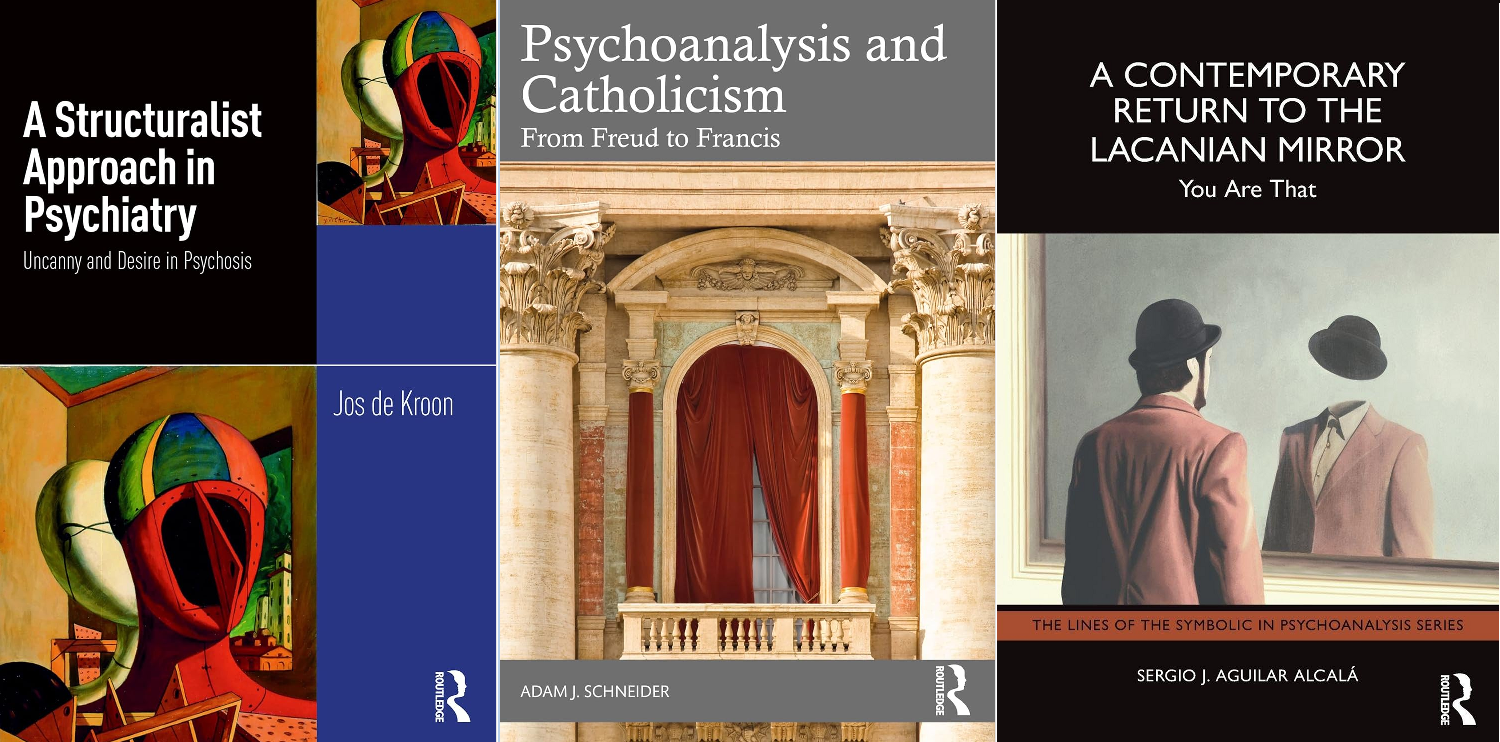
A Structuralist Approach in Psychiatry: Uncanny and Desire in Psychosis, by Jos de Kroon, has just been published by Routledge. Lacan is the inspiration alongside Foucault, Bergson, Nietzsche, Heidegger and Zizek for this alternative view of the psychiatric patient. Framed by a model of the subject presented through the Lacanian registers of the Real, Imaginary, and Symbolic, the author focuses on how the subject must reinvent themselves through speech, entailing a recognition of the place of the negative manifested in symptomatology. Capgras syndrome and Cotard syndrome as used as clinical examples, along with the phenomenon of negative hallucination. Jos de Kroom is a psychiatrist, psychotherapist and psychoanalysis working in the Netherlands.
Psychoanalysis and Catholicism: From Freud to Francis by Adam J. Schneider was also published by Routledge last month. It explores the censored history of psychoanalysis by the Catholic Church. Beginning with Pope Pius XII’s critique of psychoanalysis following his ascendency to the papacy in 1939, the same year as Freud’s death, Schneider follows the dialogue between analysis and Catholic theology up to Pope Francis whose papacy, he proposes, reflected psychoanalytic ethics. Arguing that both psychoanalysis and religion share a truth-seeking ethic, Schneider considers how both Catholicism and psychoanalysis have addressed in parallel shared concerns of repression, censorship, guilt, and the power of speech.
A Contemporary Return to the Lacanian Mirror: You Are That by Sergio J. Aguilar Alcalá was released in March and is a discussion of Lacan’s key early paper on the mirror stage from the Ecrits. Going beyond a mere commentary on this text itself, Aguilar Alcalá explores the ramifications of the mirror stage across varied experiences of subjectivity. From the aggression inherent in our relation to others, to the way we perceive social media selfies, to libidinal Marxism, this book presents the mirror stage as the crossroads for our conception of what it means to be a subject.
A Psychoanalysis Influenced by Dissidence, Decoloniality, and Feminism: De/Generating Psychoanalysis by Fernando Barrios came out last month from Routledge. Here Barrios challenges psychoanalysis with several important questions: is it a Eurocentric invention drawn from a colonial milieu? What does it have to say about the racialisation of bodies, poverty, and class? And what kind of subjectivity does psychoanalysis conceive of within systems of oppression? Both Lacan and Freud are brought into dialogue – and productive tension – with contemporary theorists of critical theory, decolonial theory, queer theory, and feminisms. The reader can expect from the book not a single thesis but “something of a collage and a montage”, “a device for intervening in psychoanalysis that repositions it in contemporary conversation.”
The Onto-Mathematical Subject: A Topological Formalization of the Zeno Drive by Robert K. Beshara was published last month. Using Lacanian topology to formalise the subject’s ontological singularity, the author presents clinical structures as specific geometric deformations. Beshara’s other work includes A Psychoanalytic Biography of Ye (about the artist also known as Kanye West) and the forthcoming Writings for a Liberation Psychoanalysis: Politicizing the Unconscious from the Core of a Crumbling Empire.
From the journals, the latest edition of The Lacanian Review, issue 18, is out now. The topic is ‘Formations of the School’ and the papers consider questions of analytic supervision, cartels, the pass, and the School. It is available by subscription via the link above, in digital and print versions, with two issues published each year. As the journal of the New Lacanian School and the World Association of Psychoanalysis, the series features testimonies of the pass, new theoretical developments in Lacanian psychoanalysis, dialogues with other discourses, and articles on contemporary culture, politics, art and science.
Upcoming Events
On Thurs 2nd April, Rendering Unconscious Center for Psychoanalysis will host Owen Hewitson (yours truly) for a presentation and discussion on ‘Unconscious Generational Transmission: A Psychoanalytic Perspective.’ This will be followed on 18th April by the continuation of the Introduction to Psychoanalysis with Dr. Vanessa Sinclair. On 1st May – for May Day – Lara Sheehi will be celebrating the launch of her new book, From the Clinic to the Streets: Psychoanalysis for Revolutionary Futures, which will be out next month. The upcoming schedule of future events has full details. All recordings from previous classes are available to subscribers here. Those from last month included Stijn Vanheule discussing his latest book, Why Psychosis is Not so Crazy, a recording of which is available to subscribers here.
Beginning on 6th April, Lacan in Australia will be offering a series of five lectures on psychoanalysis convened by Eugenie Austin. The series is free and there is no fee nor expectation of prior knowledge. Sessions will be recorded with texts and material available to participants.
Apres-Coup Psychoanalytic Association in New York is running several seminars over April in-person in NYC and online via Zoom. On 11th April, Paola Mieli will discuss identification, narcissism, and the sexual non-relation continuing her series ‘On Hate and Love.’ This will be followed by Catherine and Alain Vanier on 24th April on ‘Special Maternities: The Assumption of Subjecthood’, and the following day a Workshop on the Phantasm with the pair. The full programme for the rest of the academic year is here.
On 12th April, Lacan Toronto will welcome Stephanie Swales for a talk ‘On Not Being Empathic: Lacanian Clinical Work & Beyond’. Later in the month, on 26th April, Bret Fimiani will present ‘An Ethic for Treatment: The Rupture of Delusion and the Offer of a New Freedom for the Subject of Psychosis.’ Both talks are online via Zoom, free of charge, and with no registration required. Contact Lacan Toronto via the link above for details.
On 20th April, the Site for Contemporary Psychoanalysis will host Ben Hooson for an online event to discuss his recent translation of Lacan’s Seminar IX, Identification, and some of the challenges of rendering Lacan’s ideas into English. This event is part of a seminar series from the Site on French Psychoanalysis in Translation, which responds to the steady increase in interest in French psychoanalysis in translation over recent years. Hooson’s translation of Seminar IX can be accessed here for free.
On 24th April, Prof. Derek Hook will be the guest of the Freud Lacan Institute for an online talk on Melancholia Revisited, exploring the features and characteristics of melancholia and depression in clinical practice today.
Starting May 2nd and running through July 4th, Jason Childs and Derek Hook will be leading a new series providing ‘An Introduction to Freudian-Lacanian Psychoanalysis’. The lecture series will be online, taking place over ten 90-minute sessions, each including a lecture and discussion. Enrolment is open to all and no prior knowledge is assumed. Registration is open now via the link above.
Podcasts and Videos
On YouTube, Lacan Web Television continues to post recent talks by Jacques-Alain Miller, for which English subtitles are available. In the last month, we have his presentation ‘What kind of School for tomorrow?’, given in Paris in January. Here, Miller asks on what basis a community of psychoanalysts is constituted. Given that analysis aims for absolute singularity, how to avoid a situation in which each analyst isolates themselves in their own monologue? The role of a School in making room for critical thinking, debate, and questioning is presented as a prerequisite for a response against attacks on psychoanalysis. Secondly, a short intervention by Miller on the nature and function of comedy, remarks given at a conference in Paris last November, was also uploaded. What are the different types of laughter, and what are we laughing about? Rather than allowing ourselves to be captivated by tragedy, the Lacanian approach enables us to thwart the sinister nature of repetition. Here Miller argues that for Lacan, life is not tragic; it is comic.
Derek Hook begins a new series on YouTube this month on Lacan’s theory of the four discourses. Reviewing some of the key commentaries on Lacan’s idea, Hook presents the discourses as reoccurring structures in the social bond, meaning that each of the four discourses is essentially empty, constituting instead a bundle of formal relations.
The excellent Donald Kunze brings us two new short videos on YouTube in the past month, both on the concept of basculation, which he calls one of Lacan’s “forgotten terms.” The first video focuses on a section of Lacan’s Seminar XIII on ‘The Object of Psychoanalysis’ where Lacan considers the function of the screen in relation to the look and the gaze. The second considers the unary trait in relation to the object a, referencing Lacan’s ‘slide-rule’ analogy from Seminar XIV, his comments on Pascal in Seminar XVI, and the discussion of Velázquez’s Las Meninas in Seminar XIII.
Ordinary Unhappiness presents a marathon edition of its series on Lacan’s mirror stage on YouTube, with a bingeable 5 hours of content fit into 3 hours by speeding up the audio to 1.7x (use the settings cog on YouTube to reduce the speed if necessary). More from Ordinary Unconscious, a podcast about psychoanalysis, politics, pop culture, and the ways we suffer now, is available here.
Resources
Canterbury Christ Church University currently has one fully funded Psychology PhD scholarship available, with one of the project areas allowing the successful applicant to work on the experiences of online psychotherapy/analysis, with the potential for a Lacanian orientation. Click here for more information and details of how to apply.
On Freud2Lacan.com‘s Lacan page this month, a new translation of Eric Laurent’s paper ‘Time and Effects of Time in Analysis’, which appeared in the journal Scilicet issue 6/7 in 1976, is now available (number 226). Copies of this journal from 50 years ago (prior to its recent reinvigoration) are extremely rare, so this translation of an early Laurent paper is a valuable text indeed. Credit to Anthony Chadwick for the translation and Richard G. Klein for editing. As always, Freud2Lacan.com is a treasure trove of hard-to-find material from the Lacanian orientation and beyond.
Got news? Get in touch.
Sign up to the Newsletter to receive monthly updates on the latest Lacanian news


